I am a traveler, a writer, and a seeker of truth and beauty.
Author of THE UNINTENDED CONSEQUENCES OF NOT LIVING FULLY (Available on Amazon)
Based in Austin, Texas
After grabbing dinner at the Old Town Café in West Yellowstone, we gassed up the “Escape Mobile” and headed north to connect with U.S. 287 — a highway we had traveled countless times across north Texas, but never across Montana.
Hands down, the Montana portion is more interesting and beautifulwhile traversing the east bank of the Madison River, between canyon walls, and along the shorelines of several lakes.
Positioned in the lower western sky, the sun provided great photo opportunities of the lakes. (Photo above is Hebgen Lake.)
A particularly long stretch of a lake prompted our curiosity and called for us to stop at its overlook point. Quake Lake had been formed exactly fifty-five years prior when the combination of an earthquake, massive landslide, and subsequent rushing, rising water flooded the valley.
Just minutes after the quake and slide, the new lake began forming. In the following weeks, it grew to encompass an area five miles long and 190 feet deep.
The formation of the lake came at a great cost – twenty-eight people died the evening of the earthquake, either by drowning or being crushed in the landslide.
For Trey and I to be the only individuals standing above the former campground on the 55th anniversary date of its tragic demise, was surreal and humbling.
Dead silver treetops emerge from Quake Lake as an eerie reminder of the past.
Before continuing the drive to Butte, where we would spend the night, we said a short prayer in honor of the lost souls.
Spokane, Washington
The 316 mile trip from Butte to Spokane…included a seventy-four mile trek across the top of Idaho.
As we approached Idaho, the trees grew dense, steep ravines began crossing under Interstate 90, and fall colors dotted the hillsides.
We were in Idaho just long enough to realize we should have planned a stay there. Next time.
After settling into a hotel on the outskirts of Spokane, we headed downtown for dinner and a walking tour of the city. Spokane was a pleasant surprise because we had no expectations. No thoughts whatsoever, other than a place to sleep for the night. I think perhaps its location in eastern Washington, and its lack-luster name, conjures up images of dust and doldrums.
Spokane is the opposite — lively and lovely. The Spokane River runs through the city’s center. A river walking path was being extended as a part of a larger Riverfront Park renovation plan.
Part of Spokane’s new river-walk and Riverfront Park revitalization efforts
On to Mt. Rainier…
We stopped at a lookout point outside of Vantage, Washington to bask in our first sight of the immense Columbia River. Ginkgo Petrified Forest State Park lay just beyond the opposite bank and was once home to the Wanapums, an indigenous, peaceful tribe of fishermen who are near extinction.
Old Stagecoach/Mail Route
A few hours after crossing the Columbia, and after refueling both the car and our bodies in Ellensburg, we soon caught our first glimpse of the mammoth Mount Rainier. The sighting renewed our energy and enthusiasm for the remaining two hour drive to our campsite.
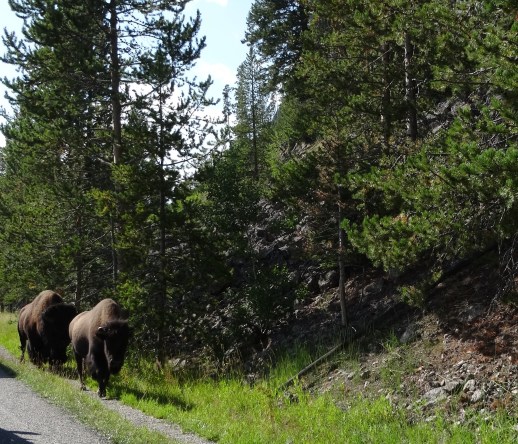
Upon entering Yellowstone National Park’s northeast entrance (located on the Montana-Wyoming border) we were greeted by Buffalo, and more buffalo escorted us throughout the 85 mile drive to the Grant Village Campground.
First stop along the trek was an overlook view of Tower Fall, the famous 132 foot waterfall of the Yellowstone River.
Tower Fall, Yellowstone River (namesake taken from the surrounding rock spirals)
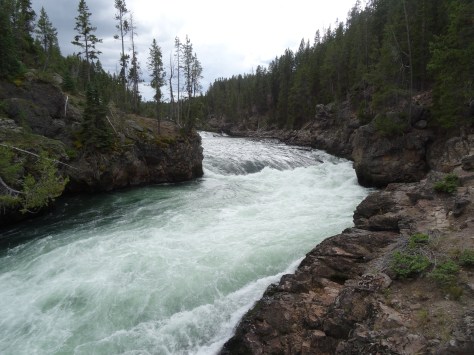
The overlook sits at the junction of the Yellowstone River and Tower Creek which also permitted us to experience the strength of the water forcing its way through the canyon.
Convergence of Tower Creek and the Yellowstone River south of Tower Fall
There is no shortage of wonders along Grand Loop Road which wends through the heart of Yellowstone and around the north shore of Yellowstone Lake. For this reason, the two-and-a-half hour drive took us about four hours, getting us to our campground with just enough daylight to set up camp and grab dinner at Lake View Cafe.
Yellowstone Lake @ Sunset
Grant Village Campground
Grant Village is located in the southern end of the park on the “west thumb” of Yellowstone Lake, and within the volcano’s caldera. Our third experience camping, and our third experience pitching our tent in the rain.
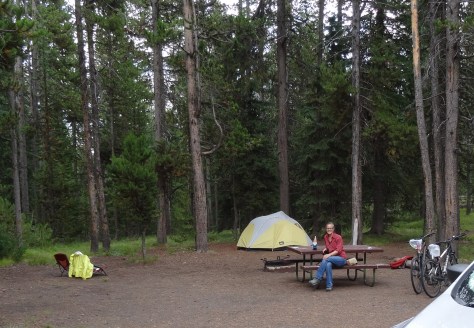
Grant Village Campsite, Loop K #391
What a great camping experience! Our site, 391 on Loop K, was spacious and sits near the ledge of a shallow ravine.
Yellowstone is wild, and camping provides a great opportunity to experience that wild. On several nights we were awakened to the howls and barks of wolves running through the ravine below.
The third morning we woke with the sun and to a strange snorting noise outside our tent. A quick look out the window eased our minds – the noises were from two elk cows and four calves grazing just outside.
The calves decided to nestle down in the grass around our tent and keep us company through breakfast.
With everything one would need from restaurants, showers, a post office, and general store, Grant Village is truly a village. We particularly enjoyed exploring the campground by bicycle and the Ranger’s educational presentations at the visitors’ center.
We learned:
Yellowstone’s supervolcano incurred three major eruptions over the past 2.1 million years, and it’s doubtful another one will take place within the next 10,000 years.
Grizzlies’ forage after dark in the summer months and during the day in the spring and fall.
The native lodgepole pine tree has a second type of cone that opens only under the extreme heat of fire assuring the species’ survival
Thermal Geysers
There are more than 10,000 thermal geysers in Yellowstone, and Trey attempted to see them all! Kidding, but at times it seemed as if that was his goal.
Of course Old Faithful was a must-see, and due to its southern location, it was our first stop.
Old Faithful erupting on schedule
Most of the geyser touring areas line Highway 191 on the park’s west side. Raised boardwalks varying in distances from a quarter mile to two miles cut between geysers and keep visitors safe from the unstable, scalding hot ground.
Sapphire Geyser
While visiting each geyser area was impossible over a five-day period, we exhausted ourselves checking out Old Faithful Basin, Biscuit Basin, Fire Hole Loop, and Norris Geyser Basin.
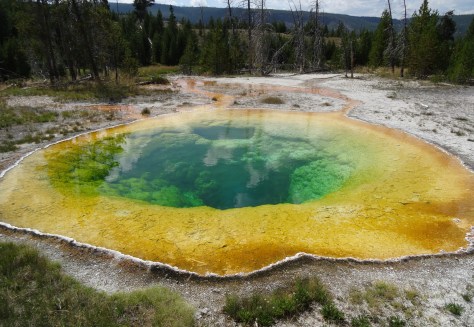
Morning Glory Geyser
Grand Teton National Park
Grand Teton’s north entrance is located 54 miles south of Yellowstone’s Grant Village which made it ideal for a day trip. After checking out Lewis Falls, we headed out of Yellowstone via the John D. Rockefeller, Jr. Memorial Parkway.
Lewis Falls, Yellowstone
Snake River, Wyoming
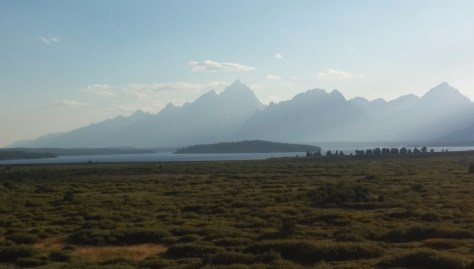
The Parkway follows the Snake River and then Jackson Lake, with the Tetons laid out along the other (west) side of the lake.
The day was spent mostly touring the park in the “Escape Mobile.” There is much to see by car including Signal Mountain, which offers great vantage points for both the Tetons and the Snake River Valley to the east.
Looking east from Signal Mountain
The initial plan was to hike around Lake Jenny, but we decided to explore more of the park rather than spend the day on a 7-mile hike.
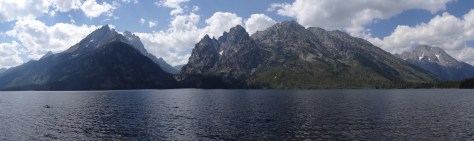
A short, but steep, hike to Jenny Lake’s edge, we arrived just as a swimmer made it across from the west side. (his arm is visible in lower left of photo)
As an alternative, we chose the shorter Taggart Lake-Beaver Creek Trail, a 3.8 mile loop. Instead of looping, we hiked about a mile-and-a-half in and backtracked. The trail offered gorgeous shots of the Tetons.
Tetons from Taggart Lake-Beaver Creek Trail
A lovely day that we ended with a fabulous dinner at the Jackson Lake Lodge, donated to the park by JD Rockefeller, Jr. Despite being under-dressed in our hiking clothes, we were seated at window table with a prime view of the Tetons.
Buffalo Chocolates
Moose butter
Vegetable Wellington
Great food! Afterwards, we stepped outside and onto the Lunch Tree Hill trail for a short hike up a ridge overlooking the valley and Grand Tetons. Trey was hoping to see moose, but the sun set while we waited.
Leaving Yellowstone
Having depleted most of our energy, we opted to pull up stakes in Yellowstone a day early, breaking up the 500+ drive to Spokane. We toured another geyser basin on our way to the west exit, where we were escorted out by more buffalo.
Note, though visiting Yellowstone in mid-August, we kept our jackets handy at all times. The evening temperatures fell into the 30’s, and some afternoons brought sudden, but short-lived, storms and hail.
We experienced two firsts during our stay in Red Lodge – we saw our first bald eagle in the wild, and we saw our first sign of the coming autumn. Both of these firsts took place while rafting (without a camera) on the Stillwater and Yellowstone Rivers. We had been hoping to spot a bald eagle as they’re pretty common in the area; the changing leaf colors on Aspens and Cottonwoods was a surprise though. It was early August and autumn was arriving. We would follow its arrival from that point across the remaining west and into the northwestern states and Canada. Much like we had followed the hydrangea bloom up the eastern states and into Vermont.
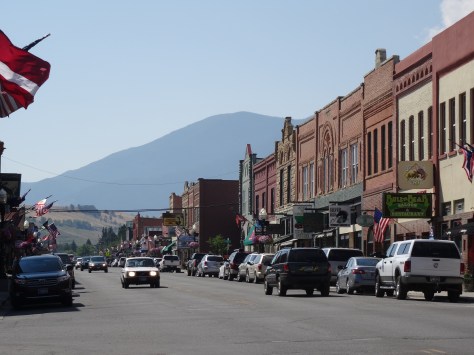
Broadway Avenue, Red Lodge, Montana
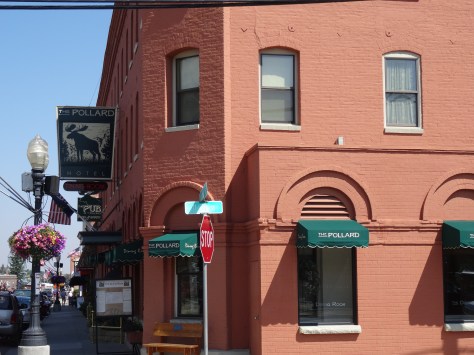
Red Lodge is a former mining town and retains the rugged charm of its past in the late 19th century brick buildings that line its main street, Broadway Avenue. We stayed in one such building, The Pollard, which claims to have hosted legends such as Bill Cody, Calamity Jane and Harry Longabaugh, a.k.a. the Sundance Kid, who ended up robbing the bank housed on the building’s first floor.
The Pollard Hotel
There’s not a whole lot to do in Red Lodge other than strolling Broadway’s sidewalks to browse gift shops and scout restaurants, of which there were many. Nightly dinner options were difficult decisions due to the many amazingly good options. We particularly enjoyed Bridge Creek Backcountry Kitchen & Wine Bar and the Carbon County Steak House, where we dined on fresh Alaskan Halibut.
For as much as Red Lodge appears to be the standard western outpost trying to attract visitors with a taste of the past, in actuality, we found it to possess a progressive sophistication. This was evident in the food, the local market and the people making a living there. There was also a yoga studio that offered destination hiking and yoga trips in the mountains that I sadly had to miss. We will have to get back there.
The adventure starts at the city’s perimeter where the Montana wilderness begins. We had received a warm welcome, loads of helpful advice and maps at the visitor’s center on our first full day in Red Lodge and then immediately headed out of town via West Fork Road to a trail labeled as a good “conditioning hike.”
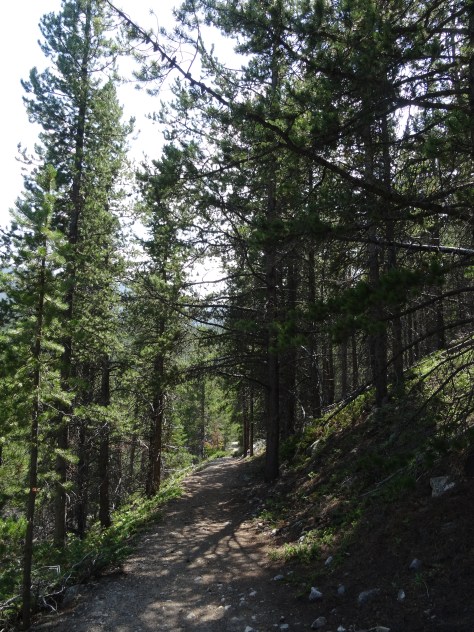
Basin Creek Lakes Trail, Trail #61
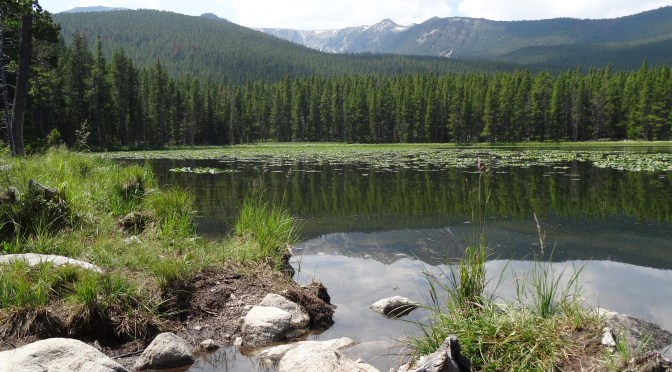
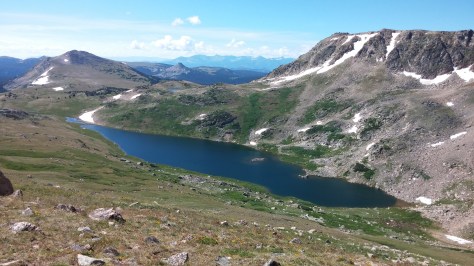
The Basin Creek Lakes Trail ascends steeply for two and half miles following Basin Creek to a lower lake and then continues for another mile and a half to an upper lake.
Basin Creek
We opted to turn around at the lower lake for a total roundtrip hike of five miles. We had started to turn around after about two miles because I was growing more apprehensive as we headed further into the wilderness. We were in the middle of grizzly country and seemingly alone on the trail…bear bait. Just as I had talked Trey into turning around a group of twenty-somethings caught up to us and then quickly passed out of sight. I decided I could make it the rest of the way and the reward for my bravery was the gorgeous scene and the serenity of the mountain lake.
Arriving safely at Lower Basin Lake
Our other outing was the aforementioned rafting trip. Adventure Whitewater is located 35 miles outside of Red Lodge near the community of Absarokee. In addition to bald eagles and fall colors, our three-hour/half-day ride included rapids on both the Stillwater and Yellowstone rivers, swimming among the currents and jumping off a giant boulder. Trey enjoyed the jump so much he hiked back up onto the rock and back-flipped off.
Along Hwy 72 on the edge of Custer Gallatin National Forest
The drive to/from Absarokee wends through the foothills of the Beartooth Mountains and was gorgeous as the sun and an approaching storm highlighted the golden rolling hills.
Our last evening in Red Lodge was spent doing laundry (there’s a nice laundromat on south end of town) and filling our coolers in preparation for five nights of camping in Yellowstone National Park.
Beartooth Pass
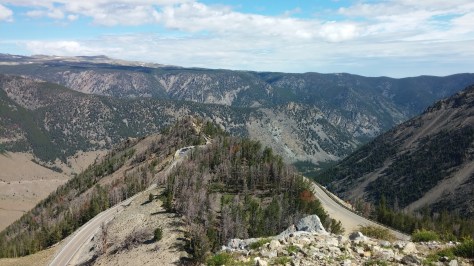
We headed to Yellowstone’s north entrance via the Beartooth Highway (U.S. Highway 212) which the late Charles Kuralt proclaimed to be the “most beautiful drive in America.”
We have to agree with Mr. Kuralt. We experienced many wondrous pathways during our U.S. tour, and Beartooth tops our list and provided us with the unique sense of driving on top of the world.
We departed Black Hills National Forest with the sunrise and via the infamous community of Deadwood, South Dakota.
Deadwood, South Dakota
Devils Tower National Monument, Wyoming
After breakfast wraps and coffee at Wild West Espresso in the also infamous ranching community of Sundance, Wyoming, we detoured 27 miles from Interstate 90 to Devil’s Tower, our nation’s first national monument under the Antiquities Act.
Beautiful Wyoming
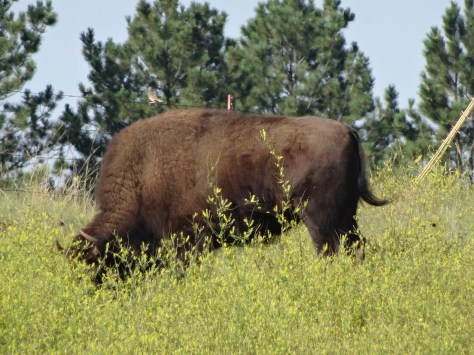
We were greeted by grazing buffalo and longhorns – sights we had not seen since leaving Texas.
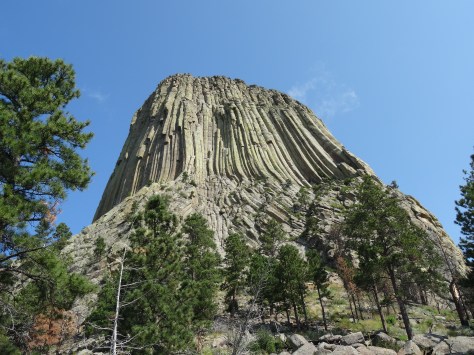
We were officially in “The West” and it was exhilarating! That feeling was amplified at our first glance of the massive igneous rock protruding from the horizon – Devil’s Tower, or Bear Lodge, one of its many native names.
The tribes of the northern plains consider Devil’s Tower sacred and regularly conduct ceremonies or leave prayer clothes and offerings at its base. Visitors are reminded to respect and honor these traditions. As we strolled around the tower’s base on the Tower Trail, we sensed a hallowedness among the rocks and colorful cloths tied around tree limbs and branches. The feeling was no less, and perhaps greater, than the feelings we experienced within the great ornate basilicas we had visited.
This church however was formed from and by the earth, rises 867 feet above it, and hosts a diverse group of plant and animal species. Its great columns cling tightly together in their battle against the elements and gravity. That’s what it looked like to me anyway. Kiowa legend states that the rock had been sculpted by the claws of a great bear – it’s easy to see that, too.
We had heard from a ranger that golden eagles were in the area and we spotted one fly over and around the tower’s top a couple of times, but the eagle was too quick for us to snap a photo.
Climbing is allowed only by permit
Little Bighorn Battlefield National Monument, Montana
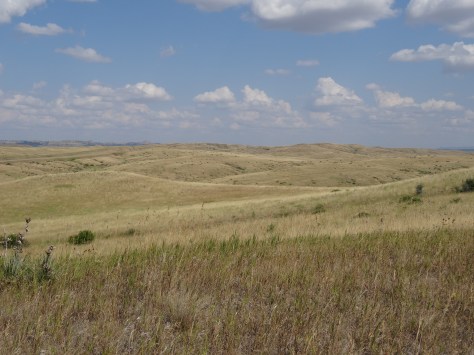
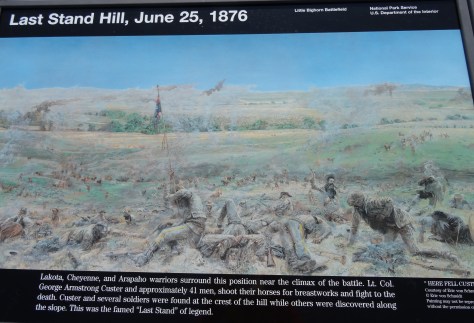
We arrived at the Little Bighorn battlefield as a park ranger began recounting the story of the U.S. Army’s 1876 effort to end the centuries old independence, cultures and customs of the northern plains’ native people.
Thousands of Lakota, Cheyenne and Arapaho had joined forces in a valley east of the Little Bighorn River where they outnumbered and overwhelmed General George Custer’s regiment of 262 men. It was one of the northern plains Indians last successful battles in preserving their identity. We had been starkly reminded of their eventual defeat while driving through the Northern Cheyenne and Crow reservations on our way to the battlefield.
The Battlefield of Little Bighorn
The young ranger confidently relayed the battle scene while pointing out specific hills and slopes that laid out before him and the crowd that had gathered. He was Crow and a U.S. government employee.
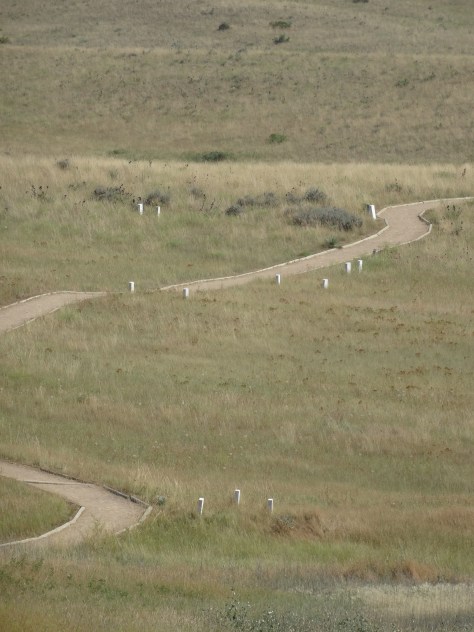
Lacking the time for a guided tour, we walked along Battlefield Road and walking paths surrounded by tombstones that had been placed where bodies had been found.
Last Stand Hill and the Indian Memorial are easy walks from the visitor’s center.
We left the monument feeling somber and wishing we had been able to spend more time there.
As it was, we had two more hours left of the seven and half hour drive to Red Lodge, Montana.
We actually took three days to drive the 1,000 miles across the remaining mid-west to its western edge in the Black Hills National Forest. Neither Trey nor I recall the exact reason, but agree that the difficulty booking accommodations in the Black Hills may have influenced that decision.
As it was, we spent the first evening after departing Chicago in Des Moines, Iowa. Not a completely unremarkable city in that we could see for miles from the unobstructed view of our third floor hotel room where we had arrived just in time to see a somewhat remarkable sunset.
We had not traveled far down Interstate 80 the next morning when I saw a sign for the turn off to Madison County and its famed bridges. We did not turn and I felt a tinge of disappointment at the time which has since turned into regret — I will have to get back there.
We were to cut up Interstate 29 just east of the Missouri River which serves as the border between Iowa and Nebraska. Instead, we detoured across the Missouri and looped through the city of Omaha just so we could say we’d been to Nebraska – a first for both of us.
The reasons behind our Black Hills booking difficulty began appearing more numerously as we headed further west – Motorcycles. As in Chicago, our visit to the Black Hills had unknowingly coincided with a major tourist event – this time it was the 74th Annual Sturgis Black Hills Motor Classic.
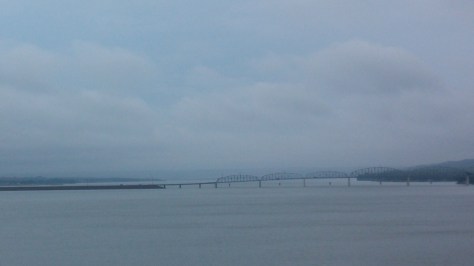
Bridge Across the Missouri between Chamberlain & Oacoma, SD
After crossing the Missouri a third time and into the town of Oacoma, South Dakota, ours was one of only a few automobiles spattered among the Harley Davidsons parked outside of the Howard Johnson’s for the evening.
Soon after departing Oacoma, the landscape changed to rolling mounds of a golden color that I had never seen in nature. I failed to capture a photo so the image lies solely in my memory.
Wall, South Dakota
THE BLACK HILLS
We had felt lucky to have snagged the last available room at the Coyote Blues Village Bed and Breakfast when we had called the owner from a payphone in Ottawa. We hadn’t know just how lucky we were until we had arrived at the secluded, yet conveniently located inn outside of Hill City, in the heart of Black Hills National Forest.
View from our patio at Coyote Blues Village
The owners are from Switzerland and were just as charming and welcoming as the surrounding environment. It was full of European charm from the Swiss chalet feel of the inn to the traditional breakfasts of cured meats, cheeses, eggs and fruit. Each guest room is decorated in a different theme. We stayed in the Turkish room and had a private patio and sauna overlooking the valley below the inn. We took advantage of the views, patio and sauna each of the three nights of our stay.
Private Patio at Coyote Blues Village
We also enjoyed breakfast each morning on an outdoor deck with friendly bikers and travelers, and loved the comradery and sharing stories of the road.
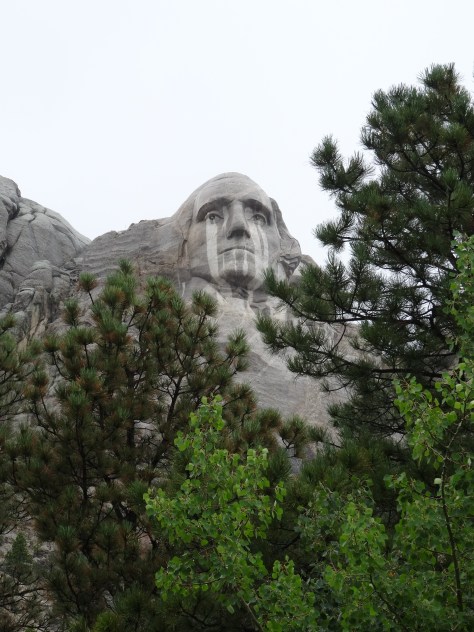
Mount Rushmore
Once we had settled into our room, we headed to nearby Mt. Rushmore with the excitement of children. It was raining and the wet winding roads were challenging for the bikers, but provided us with a unique photo opportunity.
The park service has done a nice job in tastefully accommodating thousands of daily visitors while preserving, best as possible, the mountain’s and surrounding area’s natural states. The walk way up to view the monument, along with the amphitheater at its base are a bit over the top, yet successfully achieve the goal of provoking patriotism.
Mt Rushmore Walkway
We highly recommend an evening visit for the film on the monument’s history and stories of each of its presidents.
Rushmore at Night
The evening program ended with a touching tribute to our country’s armed services’ veterans.
Honoring Veterans
Hiking in Custer State Park
Sylvan Lake in Custer State Park provides access to over a dozen trails including South Dakota’s 111-mile Centennial Trail that wends through the Black Hills from Butte Bear in the north to Wind Cave National Park in the south.
Sylvan Lake, Custer State Park
We chose, at the recommendation of a fellow traveler, to tackle the less lengthy trek to Little Devil’s Tower. The trailhead is located a mile east of Sylvan Lake’s parking lot and the trail is an easy walk through a grassy birch forest for about the first half mile…
Little Devil’s Tower Hike
at which point it becomes increasingly more difficult.
Path to Little Devil’s Tower
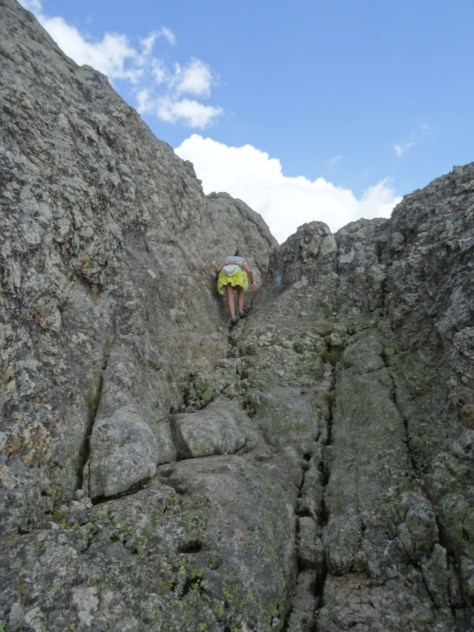
It is the last section that earns this hike the label of “strenuous” as the trail sharply ascends through and over rocky passages to the apex.
Up to the Summit!
The surrounding views from the top of Little Devil’s Tower are well worth the trip — being surrounded by the Black Hills with Black Elk Peak (Harney’s Peak at the time) and its stone tower to the north…
Black Elk Peak and Lookout Tower
and Cathedral Spires to the southeast.
View from Little Devil’s Tower
Gorgeous!
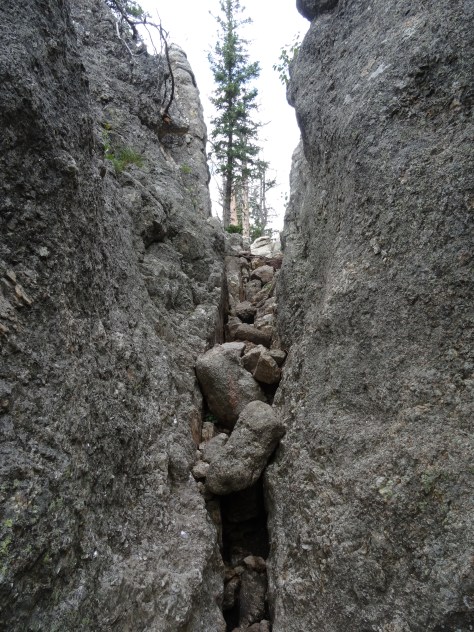
We then drove east on Highway 87 from Sylvan Lake and through a section called “Needles Highway” for the towering spires that the road twists around.
Spires along Needles Highway
Several narrow tunnels on the route limit traffic to automobiles and motorcycles, so no RV’s or trucks.
Entering Needles Tunnel, Hwy 87
Crazy Horse Monument
Crazy Horse Monument
This massive sculpture has been a work in progress since 1948 and has received no federal funding, per the wishes of Oglala Lakota Chief Henry Standing Bear who had envisioned such a memorial to honor all Native Americans. Chief Standing Bear had been inspired, so to speak, by the carving of nearby Mt. Rushmore.
The design is based on a pointing gesture and response that Crazy Horse is said to have given a snarky U.S. Calvary man who had asked him, “Where are your lands now?” Crazy Horse’s response was, “My lands are where my dead lie buried.”
Crazy Horse Model with Sculpture in Background
The carving efforts have been in the hands of a single family, the Ziolkowskis, who rely on admission fees, gift shop and concession sales, and private donations to continue their work.
To provide some idea as to how tedious the hand carving process is, Crazy Horse’s face was unveiled in 1998. To provide a sense of the size the finished sculpture is to be at some point in the future, that will mostly likely be beyond my lifetime, Crazy Horse’s pointing arm is 263 feet long and his horse’s nostrils are to be 26 feet in diameter.
~~~
The Black Hills were a fitting first step into the wild and beautiful west and provided us with a taste of the wonder that laid before us.
Up Next, Devils Tower and the Battle of Little Bighorn National Monuments…
Meanwhile, here’s some more of our favorite pics!
View of Cathedral Spires from Little Devil’s Tower
I’ve written elsewhere about our arrival in Chicago. We had been traveling ten weeks and I was tired. Chicago is where I had first begun to wonder whether it was traveling that I was actually doing, but there was still much to do and see in Chicago and beyond.
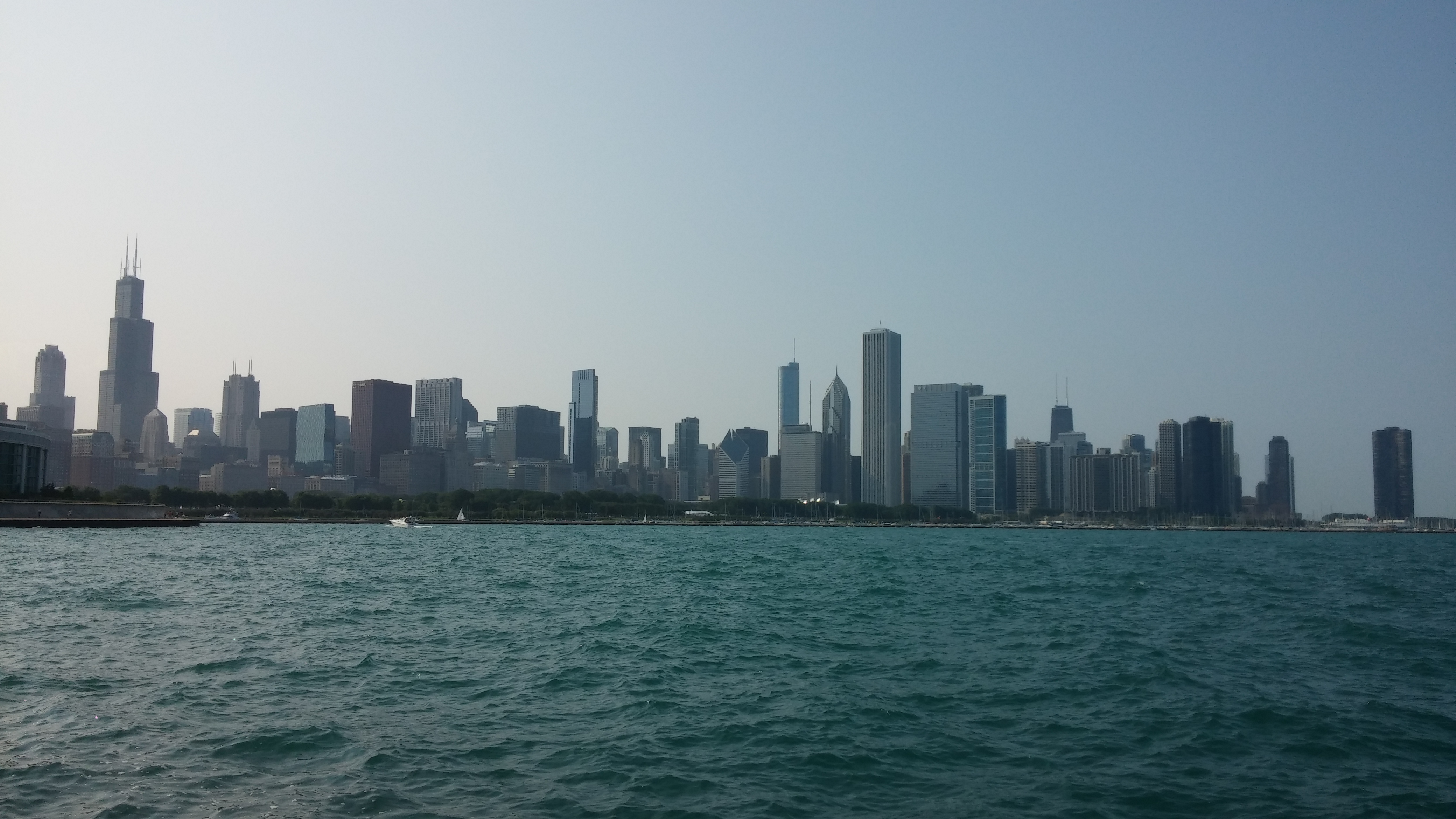
Chicago Skyline from Northerly Island
Our budget, combined with the fact that our visit coincided with Lollapalooza, had us staying in the suburb of Elk Grove instead of central Chicago as we had wanted. We didn’t realize that Lollapalooza was the cause of our displacement until we happened upon the three-day music festival while walking from the Lake Michigan shoreline to Millennium Park. By the end of our five day visit we had come to appreciate Elk Grove’s slower pace and placidity; particularly, Busse Woods, a forest preserve with seven miles of bike paths.
Busse Woods Bike Path (internet photo)
Also, Elk Grove offered some great local food options with Elly’s Pancake House, Cooper’s Hawk Winery and Lou Malnati’s for Chicago-style pizza and wine.
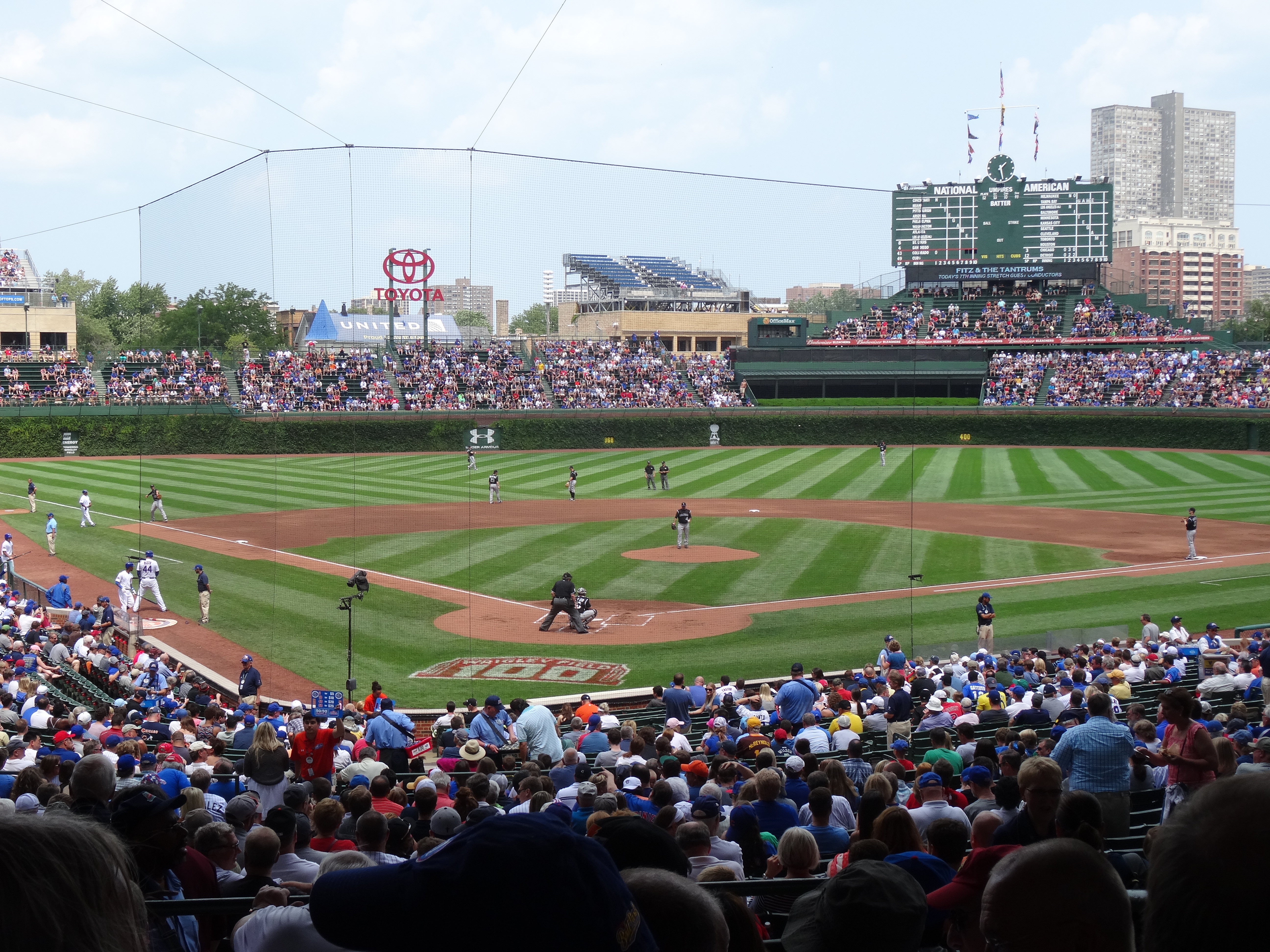
Cubs vs. Rockies
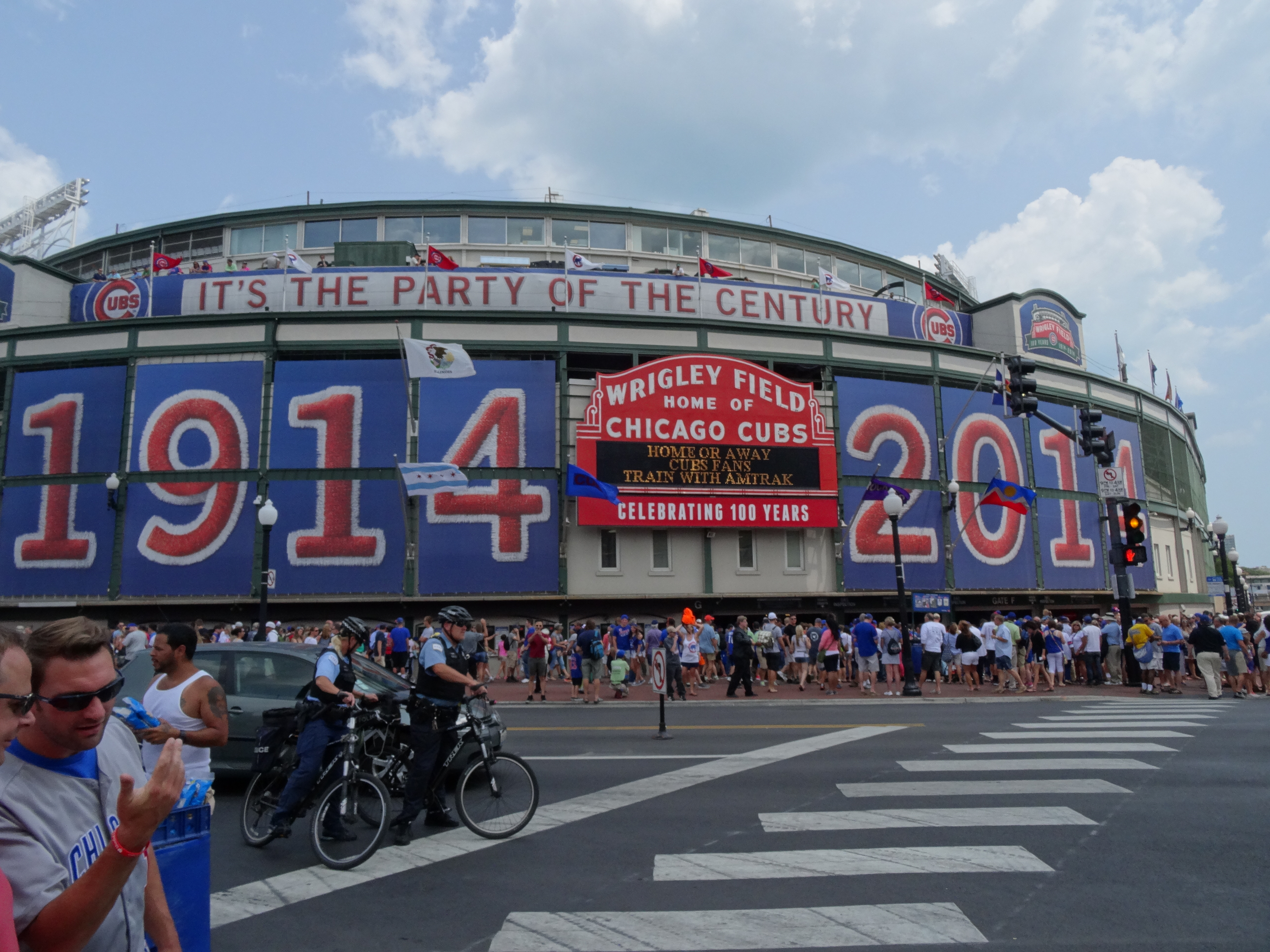
We took the Wrigley Field Express bus which dropped us off across from the stadium’s entrance and headed into the Cubby Bear bar for a pre-game dog, tots and beer. It was a lively, authentic and fun joint! And, YUM…
Dog, Tots and Bear from Cubby Bear’s Bar
Wrigley Field was the fifth MLB stadium we had visited on our tour; it also ended up being the last as our route was leading us westward and into the wilderness. We would not emerge until the first of September when we arrived in Seattle and the Mariners were on the road. By the time we would arrive in San Francisco the first of October, the Giant’s regular season was over. So, Wrigley Field was our last MLB experience, but what an awesome ending!
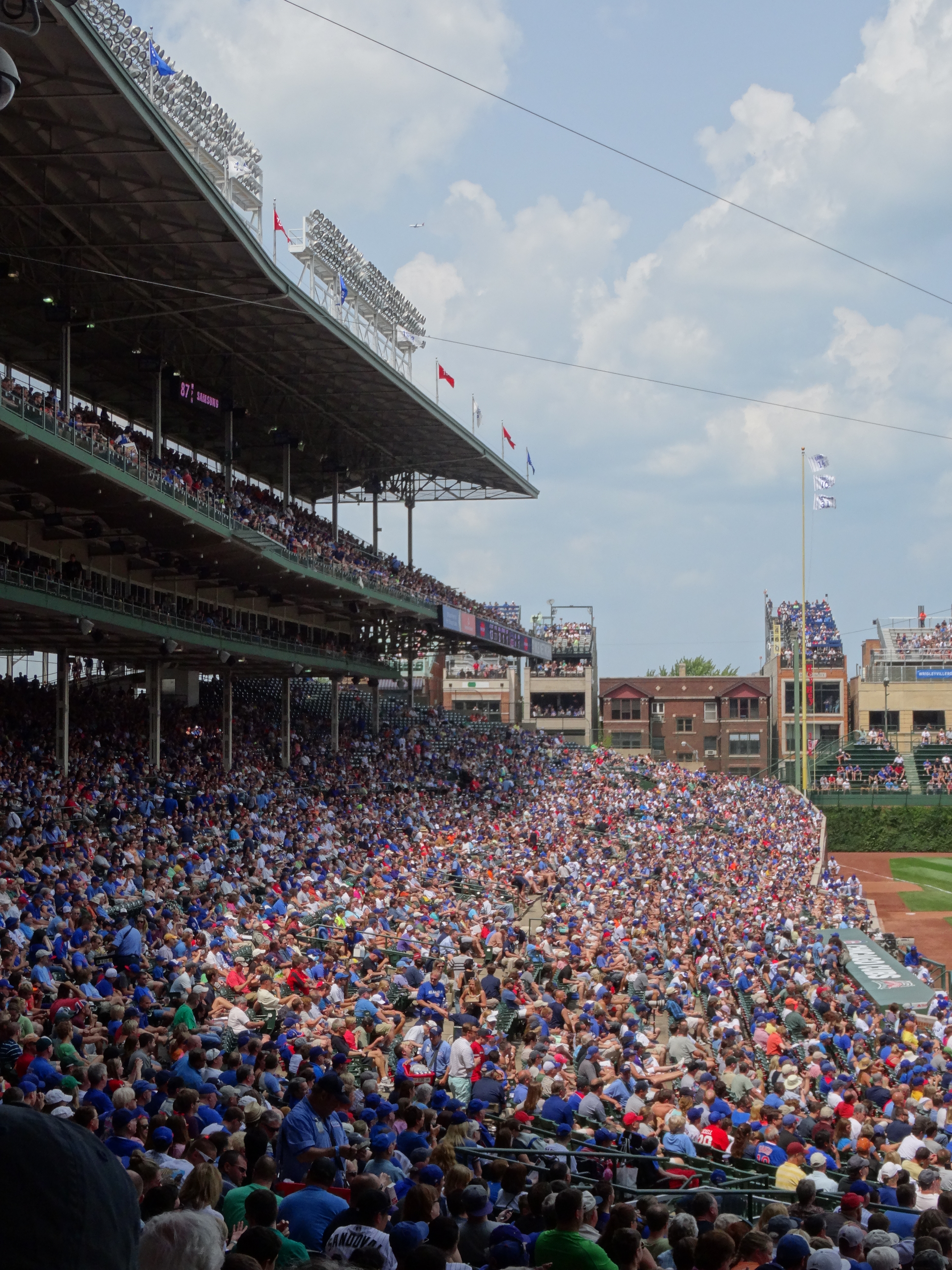
The crowd was great — if you really want to get to know the culture and people of a big city, go to a baseball game. Cubby fans were boisterous as the cubs scored the first three runs of the game which was enough to win the game.
Wrigley Field’s “Skyboxes”
Frank Lloyd Wright in Chicago
The renowned architect lived and worked in the Chicago area for the first twenty years of his career and left it with a vast collection of his prairie house designs. Most of the homes are privately owned, but there are several operated by the Frank Lloyd Wright Trust and open for tours.
Sculpture on the Oak Park grounds
We chose to tour Wright’s residence and adjoining studio in Oak Park. While the prairie home design was different, it followed basic constructs of late 19th century perceptions of what a family home should look like. Wright was only twenty-one when he designed his impressive Oak Park home and thirty when he designed the studio. I think the greatest enjoyment for me was seeing the contrasts between Oak Park and the Fallingwater residence we had visited outside of Pittsburgh.
FLW Home and Studio, Oak ParkFallingwater, Pennsylvania
The differences between each home’s environments obviously would demand and conjure up practical and creative differences, but the contrasts I’m referring to are the varying levels of Wright’s growth and development into a true creative. He was sixty-eight when he designed Fallingwater, and had obviously freed himself from designing within perceptions other than his own.
The tour took us about an hour and half and afterwards, we walked around the historic neighbor enjoying other beautiful homes. The Trust offers a self-guided audio tour of other FLW designed homes in the area but we opted to go it on our own.
Adler Planetarium
Adler Planetarium, Northerly Island, Chicago
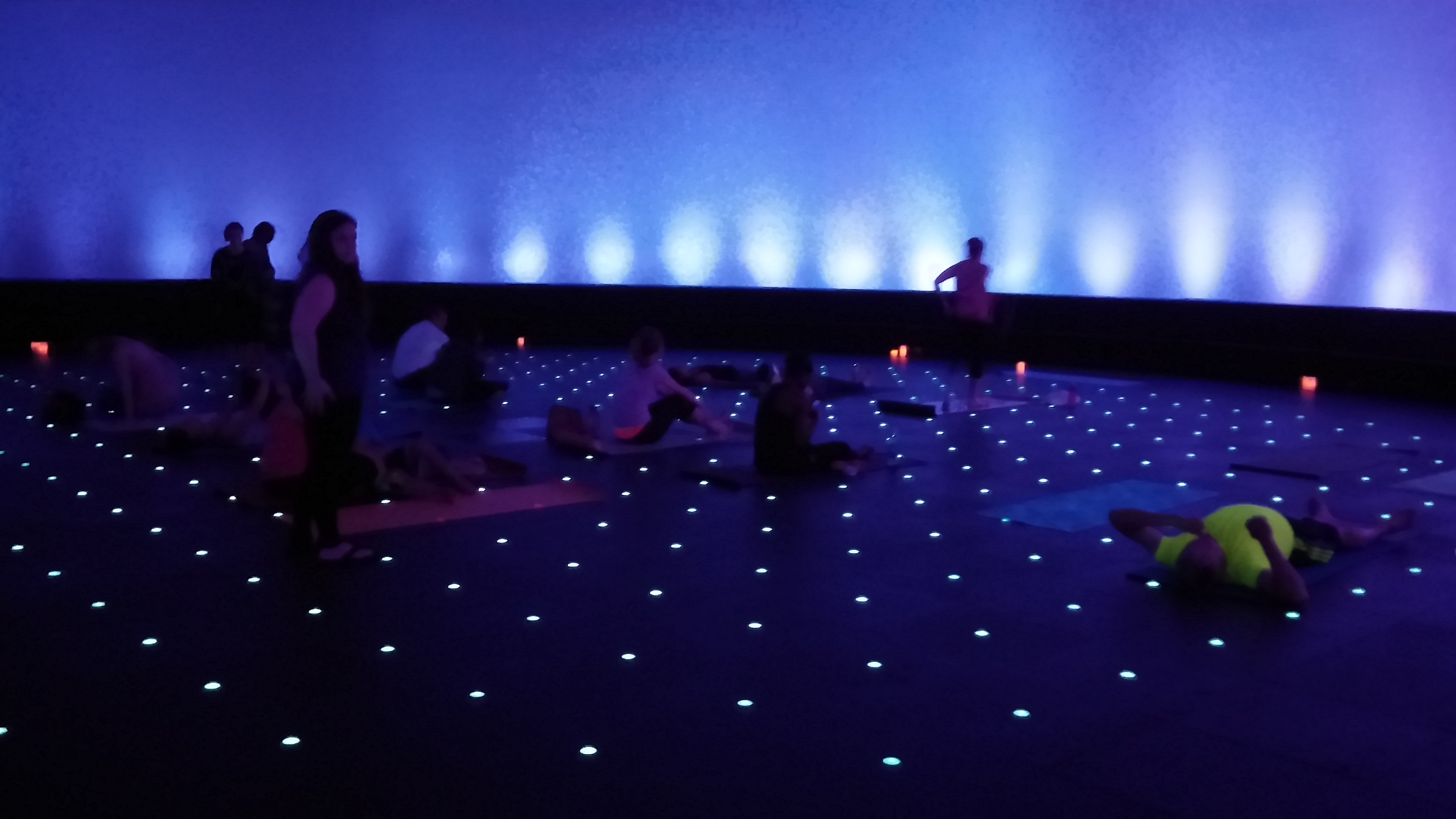
Trey joined me for an early morning yoga class at the Adler Planetarium. It was his first yoga class and as he said, “it got my heart going.” The class was held in the Granger Sky Theater and we moved from pose to pose while constellations and the Milky Way crossed above and around us. We then ended in resting pose while lying under a massive full moon. It was a pretty incredible experience for this yogi!
Yoga with the Stars, Adler Planetarium
The Adler sits on the bank of Lake Michigan, opened in 1930 and was the U.S.’s first planetarium. It continues operating as an astronomy and astrophysics research center and offers many workshops and educational opportunities to the general public. It also serves as a museum and houses some fascinating centuries-old tools used in studying, measuring and mapping the stars. One can catch a short film that carries watchers through the cosmos, or “ride” the Atwood planetarium — a metal sphere constructed in 1913 that holds eight people and rotates around them. The stars are actually light that emits from holes that were punched through the metal at varying sizes. The sphere and holes create a scale model of the observable night sky from the perspective of being anywhere and everywhere on earth.
General Sight-Seeing
There is much more to do and see in and around the area of the planetarium, including simply sight-seeing, which is what we did for the remaining afternoon. We walked along Lake Michigan and watched the boats go in and out of the harbor…
Tour Boat on Lake Michigan
…explored Millennium Park, played and posed in front of the Cloud Gate…
Cloud Gate, aka as “The Bean”
…ate tacos while listening to a salsa band on the patio of The Plaza Grill…
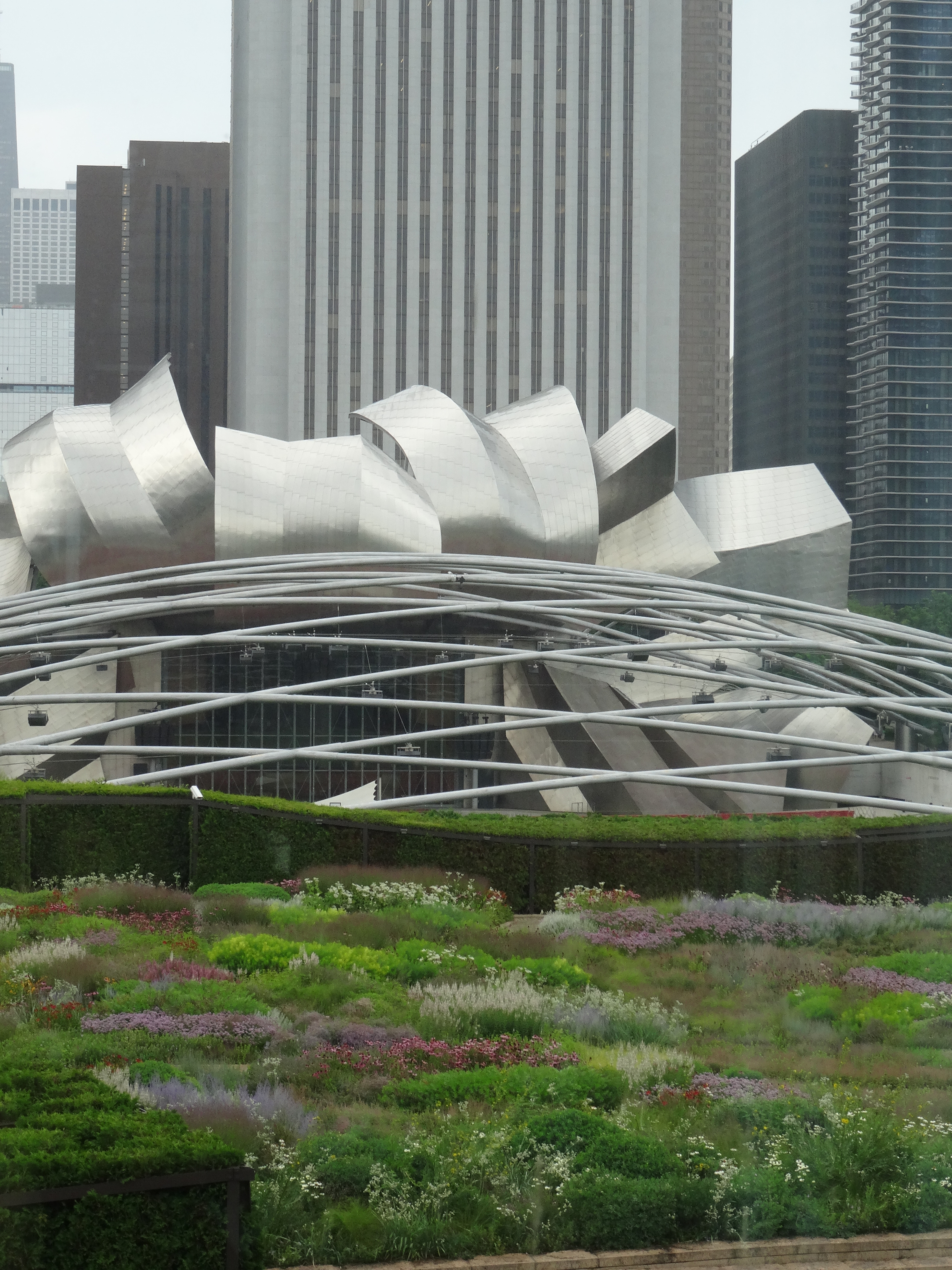
Pritzker Music Pavilion – Frank Gehry
and marveled at the abounding architecture and public art.
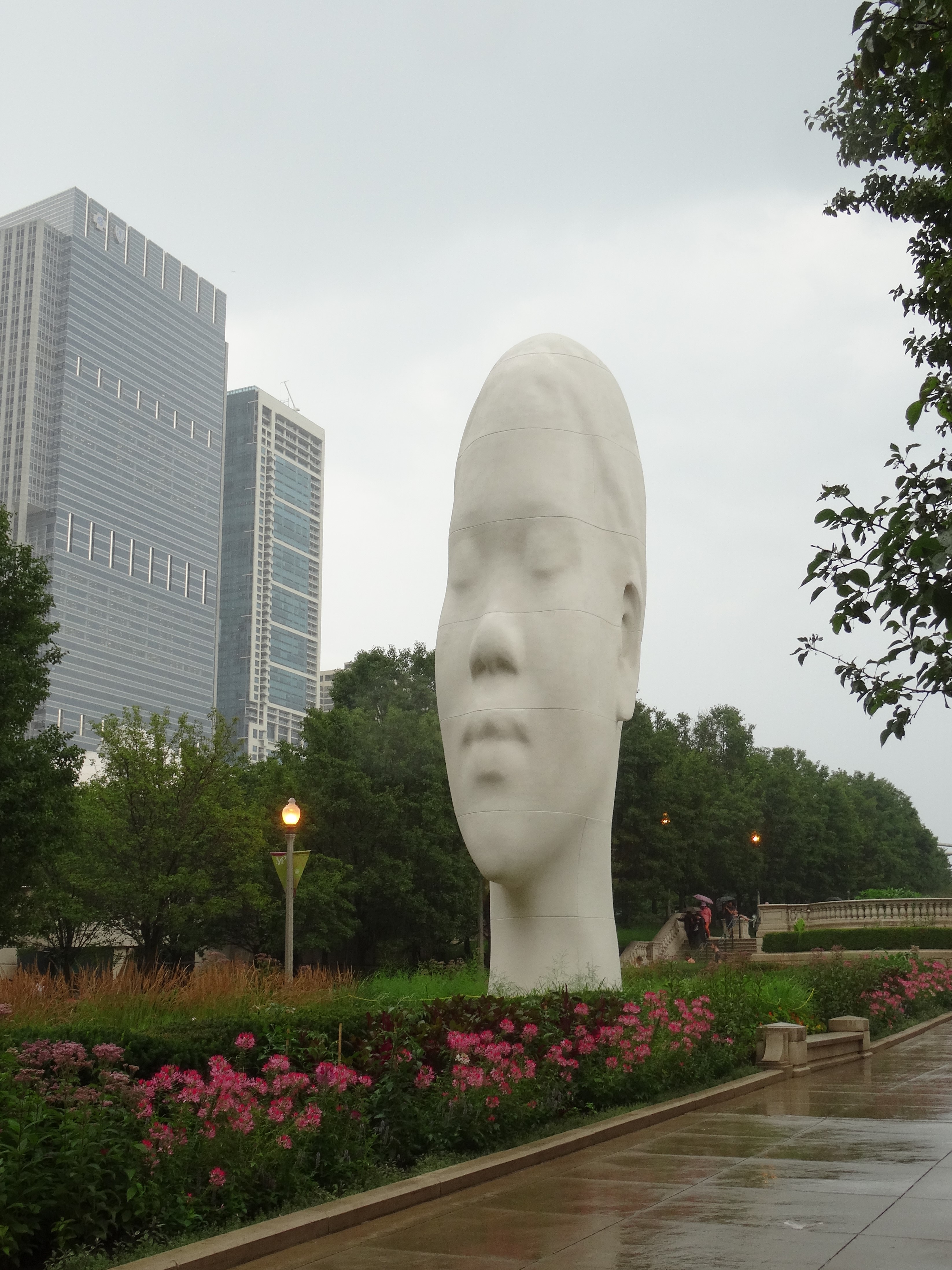
Look into My Dreams, Awilda – Jaume Plensa
Art Institute of Chicago
We’re often asked about the parts of our U.S. tour that were our favorites. Well, in the art museum category, Trey and I hands down agree that the Art Institute of Chicago was nothing short of spectacular.
Art Institute of Chicago
We had heard that one should plan to spend a day there, so, based on several past frustrating experiences in which we had not heeded such advice, we devoted an entire day to exploring the institute. It ended up not being enough time, but what we did explore of the three building, four level museum was pretty darn amazing.
Two Sisters (On the Terrace) – Renoir
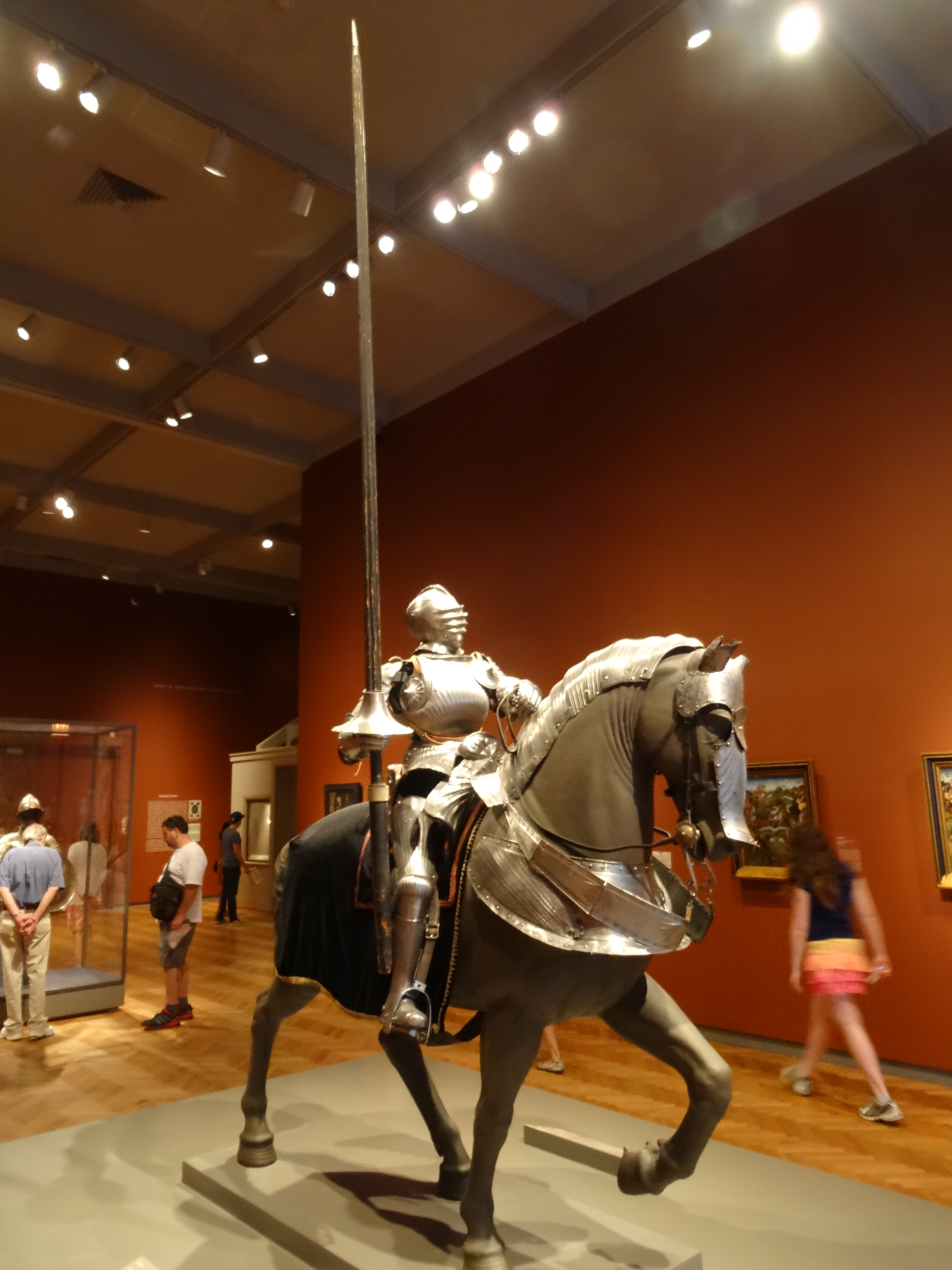
Their collection seems to represent every age, culture and medium across the globe – from ancient Greek vases, thousand year old Mesoamerican figurines, and renaissance period armor…
Jousting Armor
…to American folk art, famous modern and postmodernism paintings, mid-century architecture, and film and photograph of all sorts, to name a few.
American Gothic – Grant Wood
We left the museum with the agreement that we would visit it again and then headed off in the rain to find dinner.
Chicago in the Rain
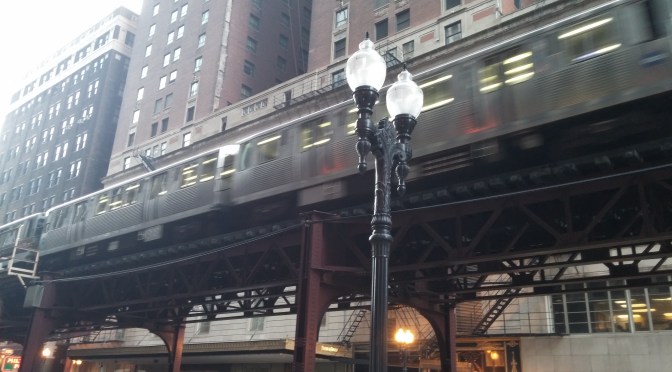
I feel that the evening walk in the rain provided us with a good sense of Chicago’s vibe and beauty.
The “L”
Dinner ended up being Italian at Tesori Trattoria and Bar. It was one of those occasions in which we were too famished to remember to take photos – a perfect ending to a perfect day. Plus, the carbs and wine helped us to get a good night’s sleep and prepare for the two-day trek to South Dakota.
Here’s more beauty from the Art Institute of Chicago…
Rocks at Port-Goulphar, Belle-Ile – Monet
The Old Guitarist – Picasso
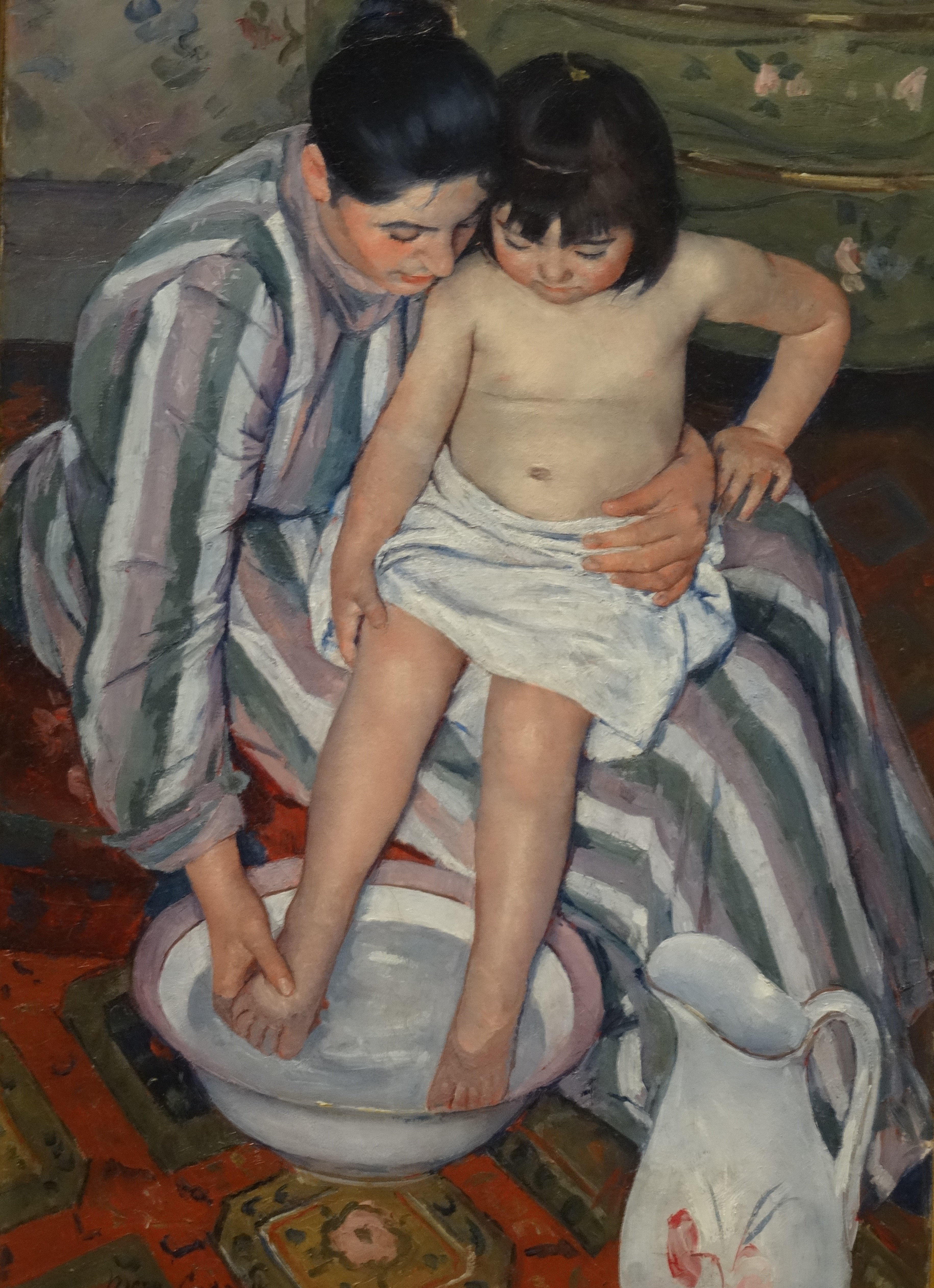
The Bedroom – Van GoghThe Child’s Bath – Mary CassattSamson and the Lion – Cristoforo StatiBuddha Shakyamuni Seated in Meditation – Tamil Nadu
We broke up the 400 mile drive from Cleveland to Chicago with a stop in South Bend, Indiana to see Notre Dame University…
Notre Dame Main Building
and take a tour of their sports facilities which was a bucket list item of Trey’s. Not because Trey is a Notre Dame fan – because he is a sports fan and he respects deep traditions in sports; and few schools exemplify deep tradition like Notre Dame.
He enjoyed touring the Fighting Irish football stadium and locker room, and the various memorabilia and commemorative statues displayed.
Trey & Lou
We were both so inspired that we downloaded the movie Rudy and watched it in our hotel room that evening.
We at lunch at the base of “Touchdown Jesus”
We also enjoyed the beautiful Notre Dame campus which included the Basilica of the Sacred Heart, the third such Catholic icons we had visited since our departure from Austin two months prior (see Montreal and Ottawa).
Ceiling of Basilica of the Sacred Heart
There was a “grotto” adjacent to the basilica that had been built into a hill and offered students a peaceful space for lighting a candle, contemplating and praying.
Grotto of Our Lady of Lourdes, Notre Dame
I’m sure it stays busy during finals week, but Trey and I were glad to take advantage of its quiet solitude to sit, rest and listen to the birds.
I found South Bend charming and a bit of a sleepy city. Of course, this was from the perspective of visiting at the end of July. Like most college towns, we were able to easily navigate the city by bicycle, and particularly enjoyed the East Bank Trail that followed the St. Joseph River into downtown South Bend.
Here, the St. Joseph’s is dammed up with concrete walls to create an aesthetically pleasing town center around the water.
Fish ladders were added to the east side of the river in 1987 as a solution to the disrupted salmon and trout migrations from Lake Michigan.
Fish Ladder on the St. Joseph
There were huge trout making their way through one of the ladders but we were unable to catch one on camera.
We also failed to capture the beautiful Italian dinner we enjoyed at Carmelo’s.
Next, on to Chicago and the rest of this travel story…
The second of four official direction changes we made on our circle around the U.S. technically took place on July 8th when we departed Maine. However, the left turn we made onto Interstate 76 just north of Pittsburgh felt more like a true shift in direction as we felt the vastness of the west laying before us. This would have been a bit daunting except we had decided to break up the initial westward drive with several stops in Midwest cities. The change in scenery was almost immediate as we entered eastern Ohio and became bounded by lush cornfields. In fact, cornfields were the dominate landscape across the entire Midwest and for the next 1,000 miles of our trip. This provided me with a new perspective on the corn industry…it’s freaking huge!
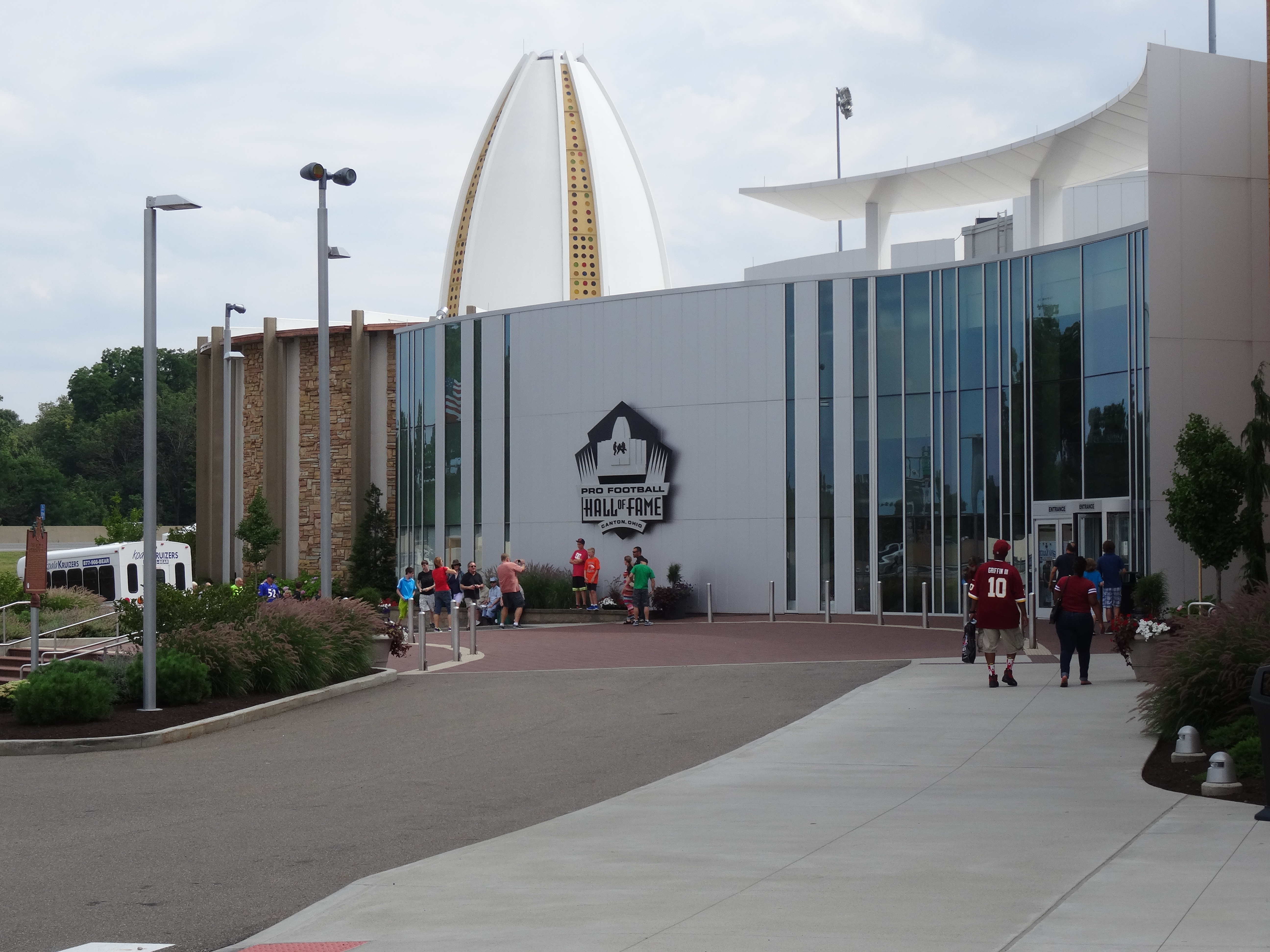
Pro Football Hall of Fame – Canton, Ohio
Pro Football Hall of Fame, Canton, Ohio
The Pro Football Hall of Fame is located in a Canton neighborhood bordering Interstate 77. We paid $10 to park at an offsite lot and noted an energy and excitement in the air on the walk to the main entrance – a route that took us past a high school and its football stadium, which also hosts the annual NFL Pro Football Hall of Fame game, and past several homes.
Story of why the Pro Football HOF is located in Canton
Once inside, we discovered that the excitement was in preparation for the festivities leading up to the 2014 induction ceremony that was to take place the following weekend.
We were glad to find that our AAA membership allowed us to receive a discounted admission price of $20.70 each. Our late departure from Pittsburgh and the two hour drive left only a couple of hours to tour the Hall of Fame before it closed. We knew this would not be sufficient time, but decided to continue with the plan and take in what we could.
Trey & Heisman Trophy
I enjoyed learning the history of football and seeing examples of its evolution through time, and Trey loved seeing the memorabilia and exhibits of his heroes!
All inductees are honored with a bust displayed in the main hall — here’s Tom Landry and Earl Campbell
Rock & Roll Hall of Fame and Museum – Cleveland, Ohio
We rolled into Cleveland as the sun was setting and as it started to rain – a welcomed respite from what had been one of the warmer days to date. We used hotel points to stay at a Westin in downtown Cleveland and located a couple of blocks from the Rock and Roll Hall of Fame and Lake Erie’s shoreline.
The fact that we were staying in a hotel was a treat in itself — a treat that was made even sweeter as we checked in and found out that it was a brand new luxury hotel and we had randomly been upgraded to a junior suite. Another gift from the Universe to be fully embraced and appreciated!
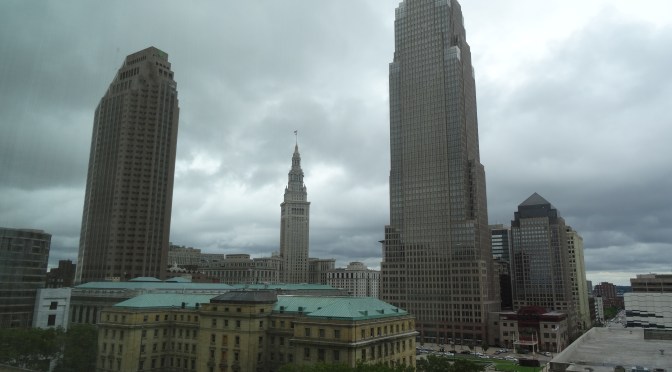
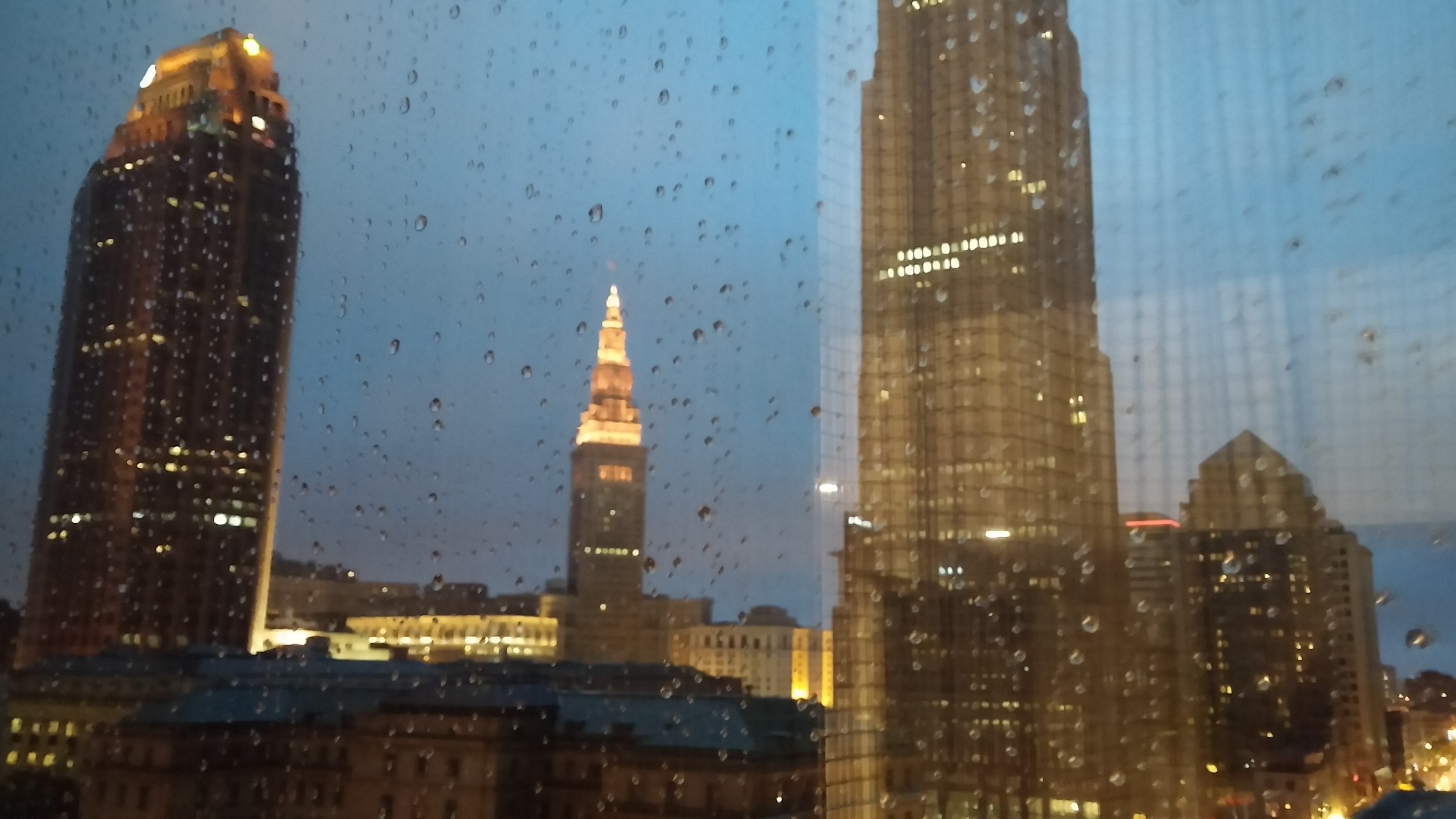
Rainy view from the Westin
Cleveland quickly exceeded our expectations, or rather any expectations that we would have had if we had been there for anything other than touring the Rock and Roll Hall of Fame. As it was, we were pleasantly surprised to find a lovely city with a seemingly successful revitalization effort occurring downtown. There was a youthful presence on the streets, and fun vibes in and around the restaurants and bars located near our hotel.
We decided to embrace the comforts of our gifted junior suite and heed to the needs of our bodies by catching up on some much needed rest. This had us arriving at the Rock n’ Roll Hall of Fame at 1pm rather than when it opened at 10am. We had been told that we needed to allow a full day to see everything and found this advice to be correct. We made the most of the 4 ½ hours we had by prioritizing which floors and exhibits were a “must see.”
The Boss’ notebook – Hungry Heart
The number and quality of rock n’ roll artifacts were astonishing, making the $23.35 admission price seem very reasonable.
Porsche belonging to the late great “Pearl of Port Arthur”
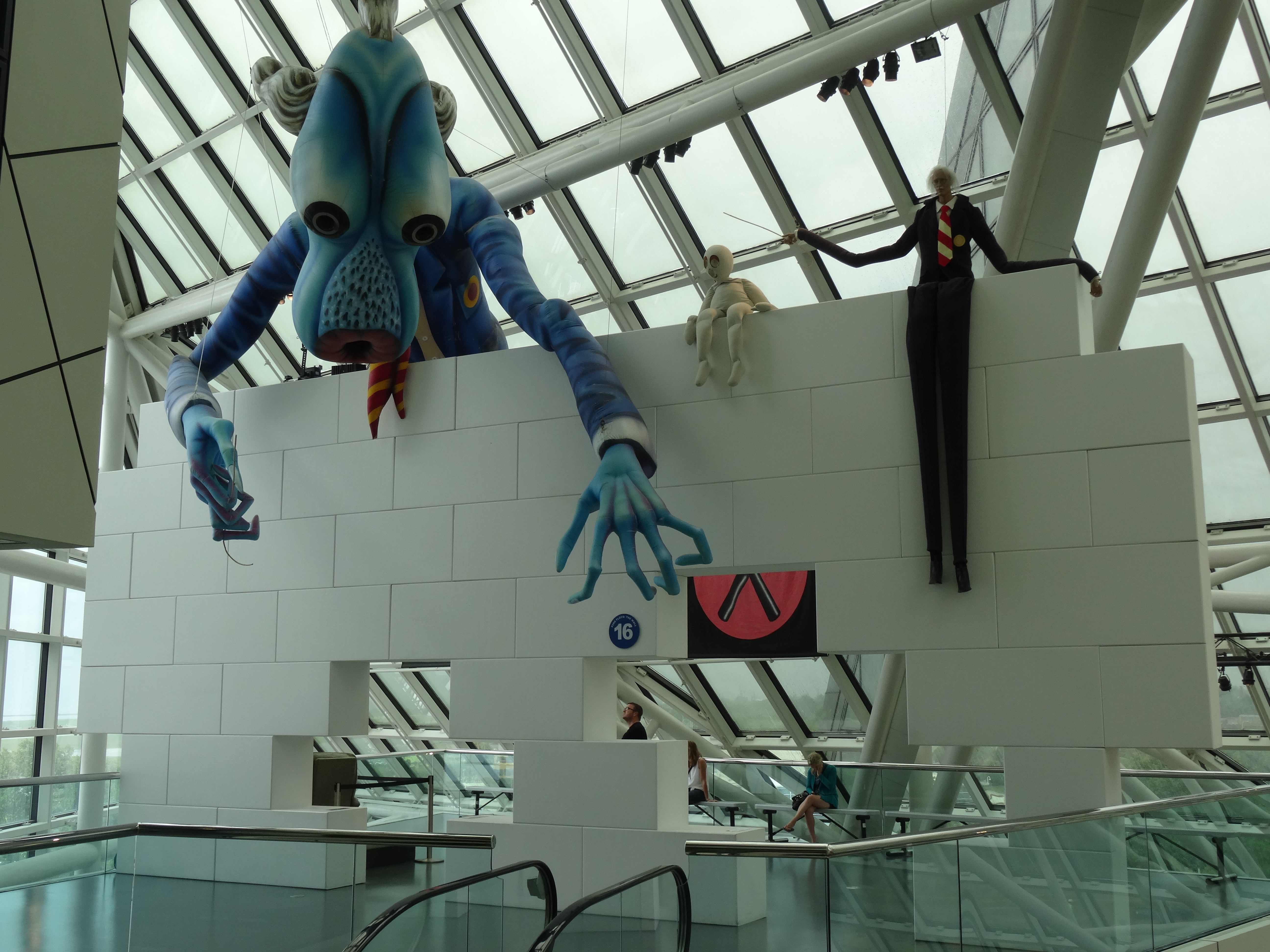
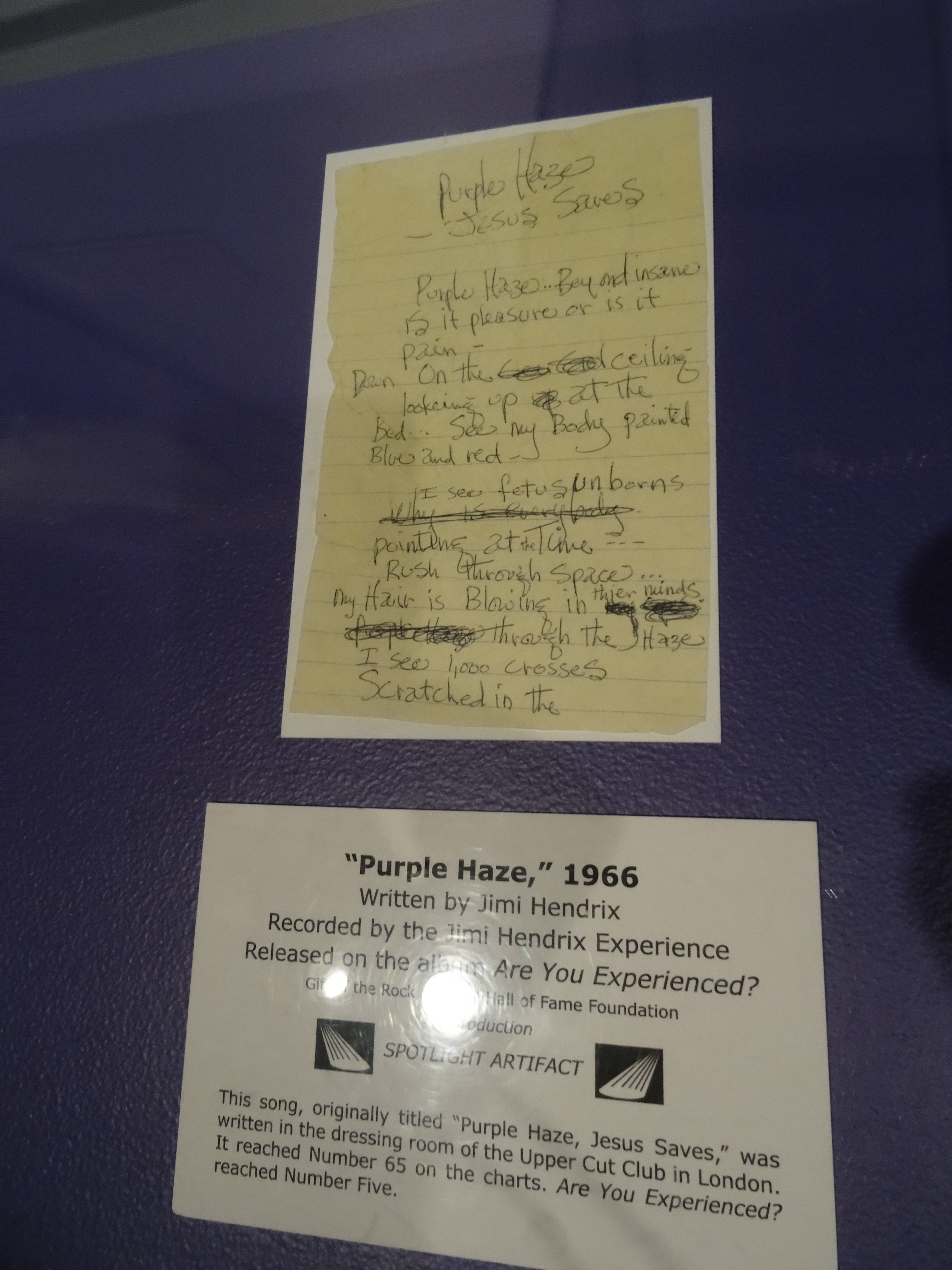
Highlights for me were Janis Joplin’s Porsche and Bruce Springsteen’s notebooks of handwritten lyrics, and Trey enjoyed the Pink Floyd tribute.
Another Brick in the WallJohn Lennon’s from Sargent Pepper’s Lonely Hearts Club Band
We did have one critical observation: The story of Texas’ musical roots in blues and rock, and the artists that planted and sprang from those roots, is noticeably missing. Yes, there are exhibits of various Texas artists scattered throughout the exhibit halls, but not in an organized wholistic way that pieces together and reflects the big, authentic picture.
There are such exhibits for Detroit, San Francisco and Seattle and I am not denying that these cities’ musicians have made huge contributions. I just don’t understand how their influences on specific genres are recognized while Texas’ overall influence and undeniable contributions are completely ignored. I think we would still feel this way even if we could claim to be completely unbiased.
Hendrix Purple Haze LyricsHendrix
Cleveland Food
The Blue Pointe Grille…
High quality seafood options with superior service. $$$$
We also enjoyed brunch at The Nauti Mermaid, a nautical themed bar and restaurant, but forgot to take photos due to hunger.
The older of our two daughters, Lindsey, lived in Pittsburgh for six years – four while attending college and two after graduating. Despite our many visits during this period, we never had the opportunity to explore Pittsburgh properly because our visits were either planned around helping her move or coordinated with also visiting family in Washington D.C., and our younger daughter who attended college in New Jersey.
We were looking forward to finally spending proper time in Pittsburgh, a city we quickly realized was not the old steel town we had imagined when our daughter expressed interest in attending college there.
Pittsburgh Skyline
No, it is a beautiful, vibrant, culturally rich city with a unique personality of its own thanks to the people that call it home. Their love of their city is evident.
One of the best vantage points to appreciate the city’s beauty can be experienced when traveling into Pittsburgh from the west on Interstate 376 which is the route from the Pittsburgh airport. The Interstate goes through Mount Washington via the Fort Pitt Tunnel, and the city suddenly appears laid out below when emerging from the tunnel’s other side. We were fortunate to be required to take this route into the city from Niagara Falls, New York.
We settled into an Airbnb cottage near Highland Park around 5:30 p.m., then rested before heading out by foot to explore the neighborhood. A friendly youth baseball game was taking place at a nearby playground and we stopped and watched as the sun was setting. Trey pulled his pocket notepad out and we planned how best to spend the next three days.
Prioritizing our plans for Pittsburgh…
Our first day touring Pittsburgh was done by bicycle and our first stop was a nostalgic one – Ritters is a breakfast joint near the UPMC complex and in the Bloomfield neighborhood where we feasted on buckwheat pancakes and breakfast potatoes as we had done many times in the past with Lindsey. After the hearty breakfast (which we needed in order to tackle Pittsburgh’s hills on bicycle) we headed out to visit her other old haunts, perhaps in attempt to recapture the excitement and recognize the challenges of a time in our past.
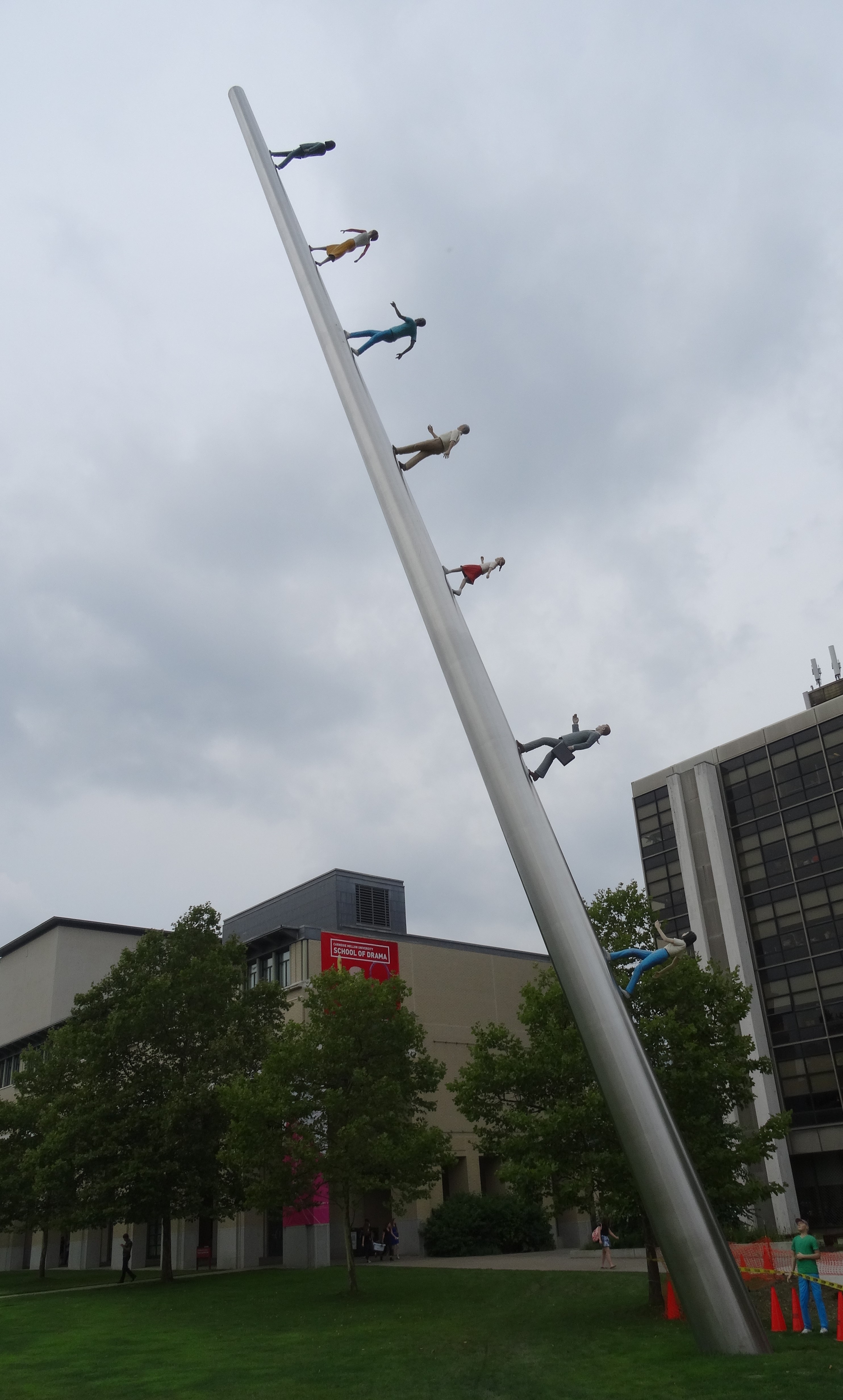
CMU College of Fine ArtsCMU “Walking to the Sky” Sculpture, but the students refer to it as the “Stairway to Heaven”
Being the middle of summer, the Carnegie Mellon University campus was quiet and provided clear pathways to bicycle through the small campus and into and out of the adjacent Schenley Park.
Pittsburgh’s Schenley Park
Pirates vs. Dodgers
PNC Park sits on the Allegheny River across from downtown and near the point where the Allegheny, Ohio and Monongahela rivers converge. There were plenty of public garages downtown to choose from for parking and you can get a real sense of the spirit of the city and its sports fans on the walk across the Roberto Clemente Bridge.
This bridge serves as the gateway to the stadium – its grand entrance supported by the excitement and the energy of pirates’ fans anticipation of a big win – I think “Yinzers” always expect to win.
With great fifth row seats looking over right field, PNC stadium provided the most intimate experience of all the ball parks we visited. We were looking directly down on Gregory Polanco, and he and the other outfielders regularly engaged with fans. The Pirate fans around us set the tone of positive excitement and rallied on their heroes throughout the entire game – it was great fun, largely, I suspect because the Pirates led the entire game and beat the Dodgers 6-1.
Falling Water
Day two started with another nostalgic breakfast. This time at Pamela’s in Shadyside for more Pittsburgh-style fried potatoes. We then drove the Escape Mobile to Frank Lloyd Wright’s secluded architectural wonder located about 80 miles southeast of Pittsburgh – a bit of a trek, but well worth the roundtrip drive.
Frank Lloyd Wright’s Falling Water
Wright masterfully melded the structure, a family home, with its environment – a rocky creek gradually descending through a wooded sanctuary of oak and maple trees. The main structure of the house sits above the creek and each level opens onto an outdoor space that overhangs the creek providing the sense of being in a tree house from every room.
The guest house sits above the main house and I was glad that it was open to the tour as it was not open during my trip to Falling Water in the fall of 2002. At that time, cable supports for the main house were being installed to keep it secured on and above the creek bed, instead of in it. Restoration work was underway on the main house’s chimney and roof of the guest house. It was very evident that this national landmark is well cared for and its overseers, The Western Pennsylvania Conservancy, take their mission to preserve Falling Water for future generations very seriously.
Strip District
We stopped in Pittsburgh’s Strip District to eat on the trip back from Falling Water. The Strip District sits along the Alleghany’s eastern shore which was once a thriving industrial area. During that time, small retailers set up various shops and were supported by the workers. The industries are gone, but some of the Strip District shops remain and provide a glimpse of how shopping was done before large all-in-one grocery stores took over. For instance, there’s a cheese shop that sells only cheese and a meat market shop that sells only meat. Many of the old shops and warehouses have been taken over by restaurants, art galleries and touristy type shops making it popular area to visit and shop by both locals and visitors. However, being a Thursday evening, we found the choices of restaurants to be limited so settled on Café Reyna for decent Mexican food.
Mattress Factory
Came across this sign on the MF’s Annex building. Very fitting and so true!
Friday was museum day. The Mattress Factory is an installation art museum. It provides housing for visiting artists while they work on their pieces. Lindsey had the privilege of working with several artists on installations during her time working at the Mattress Factory.
Our timing had us visiting between installations so only the permanent installations were available in the main building – lots of fun showing Trey around and experiencing them again. We found out that there was a new exhibit in the Mattress Factory Annex building around the corner. Trace of Memory by Chiharu Shiota encompassed the entire three story row house and was quite an experience.
“Trace of Memory” Installation @ Mattress Factory Annex
Shiota had woven black yarn throughout like thick spiderwebs, obscuring a seemingly typical household and successfully creating the eerie perception of walking through someone’s dream or distant memory.
Andy Warhol Museum
We happen to visit the Warhol Museum during their regular Friday evening event in which they offer ½ priced admissions, light snacks and a cash bar – so wonderful and appropriate to experience Warhol with a cocktail in hand!
Unlike my visit in 2002, photographs were not allowed inside. Rightly so, because any photo that I post here could not possibly do justice to an original Warhol. The colors would lack the vibrancy and verve, and the thumbnails would remove any ability to conceive the scale and energy of the original pieces. These can only be experienced in person; so, like Falling Water, the Andy Warhol Museum is a must visit when in Pittsburgh.
Leaving Pittsburgh
I had packed my yoga mat in the back of the Escape Mobile but had not yet put it to use. I was glad to be in a city such as Pittsburgh where studios were abundant. I arose early on Saturday, our last day in Pittsburgh, and took a very much needed and revitalizing drop-in class at Yoga on Centre. This was my first yoga experience outside of Austin and I realized that I, and my body, had been missing yoga, so decided that I would make effort to look for classes from that point.
Our Airbnb host was a bit upset that we had yet to try any of his restaurant recommendations. Highland Park is apparently full of great restaurants and hot spots and somehow we got to Saturday without having ventured to a single one. As we packed the Escape Mobile we promised him that we would catch brunch up the street at Park Bruges.
Con Huevos Ros & Banana Walnut French Toast from Park Bruges
So glad we did – Park Bruges was by the far our best food experience in Pittsburgh.
We also had yet to make the drive up Mount Washington to enjoy the scenic views of Pittsburgh and its rivers.
View of Pittsburgh from Mt. Washington
This is the same view we experienced when we emerged through the Fort Pitt Tunnel upon arriving in Pittsburgh, only weren’t traveling 60 miles per hour.
Toronto was the largest of the three eastern Canadian metropolises that we visited. It sits on the northwest shore of Lake Ontario above and across the lake from Buffalo, New York. It was also the most mainstream, or American-like, city and was obviously in the middle of an economic and building boom – only our home of Austin can compete with the number of building cranes that were in downtown Toronto!
Toronto Skyline
The fact that Toronto is Canada’s business and financial center made staying in the city center out of sync with our budget. Not a problem though, the Parkview neighborhood in East York was a 15 minute drive from downtown and a short bike ride to Lake Ontario’s beaches and Toronto’s immense park system.
Our host was new to Airbnb and had just finished a complete remodel of her basement apartment. We also had access to her backyard hot tub. Trey loves telling the story of soaking in the hot tub and looking up to see a family of raccoons coming through the backyard fence, crossing the yard in front of us on their way to their apparent home under the deck on which we were sitting.
We were glad to be Caroline’s first guests. She and her boyfriend were kind enough to invite us to join them for dinner. Our first evening in Toronto was a wonderful time of sharing stories and getting to know our lovely host. It was one of our best Airbnb experiences as many times you never get the opportunity to meet your host.
Toronto vs Texas
We headed downtown to Rogers Centre, the Toronto Blue Jays baseball team’s stadium, well before the game’s noon start time. This gave us an opportunity to walk around downtown a bit and get a feel for the city. It was also our intent to grab breakfast but found that our options were limited. We passed up the Texas Lone Star Grill – just didn’t seem right – and instead decided to push the clock and wait in line to be seated at Cora’s. Glad we did – Cora’s has been a favorite of Canadians since 1987 and is known for their generous portions of fresh fruit and unique breakfast presentations. For instance, Trey had the Crepomelette – a western cheddar omelet rolled into a crepe.
Rogers Centre was the third major league baseball stadium we visited on this tour, and we were lucky with the schedule as the Blue Jays happen to be hosting Trey’s team, the Texas Rangers.
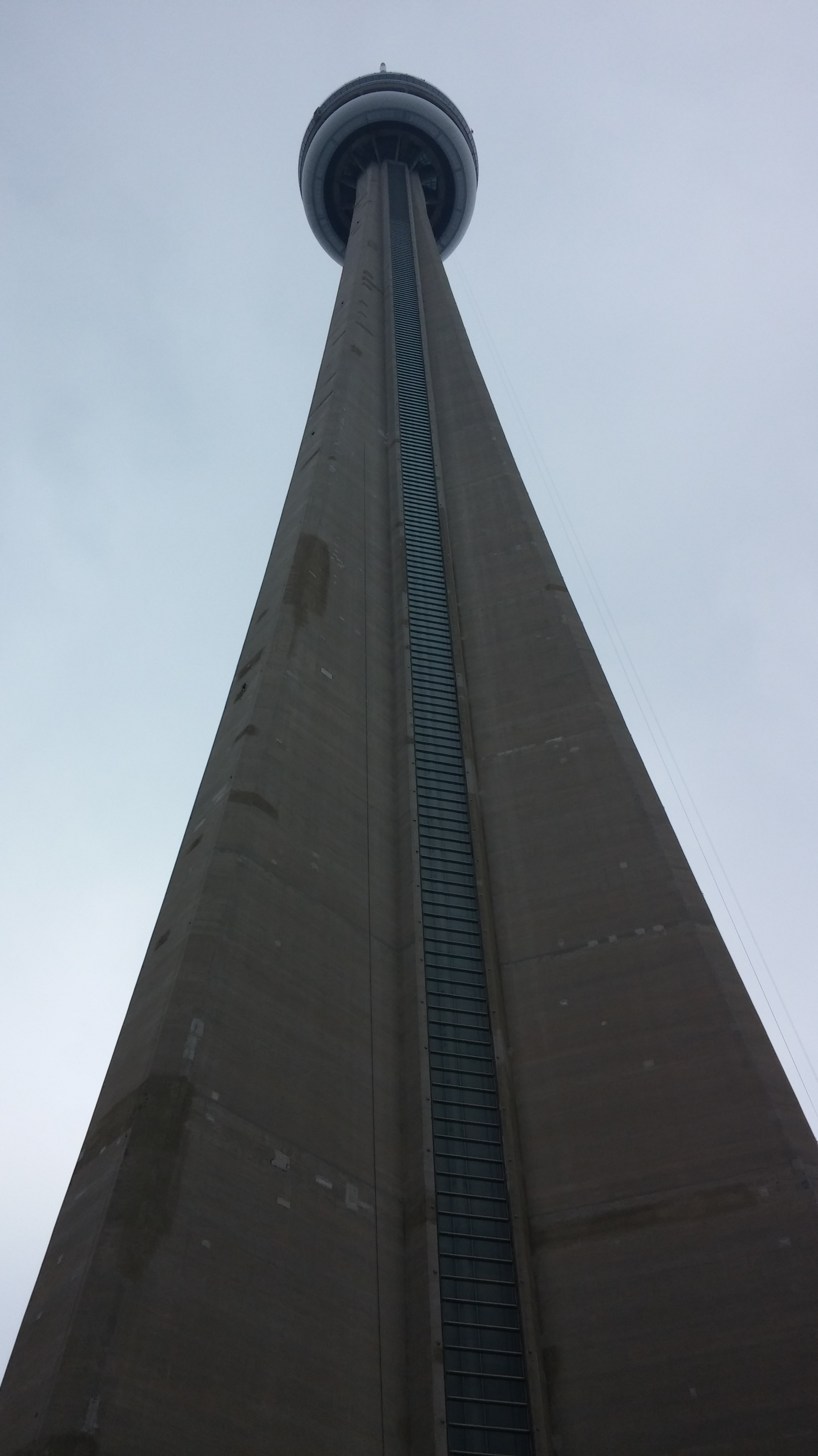
CN Tower, Toronto
The stadium is located at the base of the iconic CN Tower and is quite modern. Its retractable roof was adjusted regularly with the movement of the sun, and I was surprised to see that the stadium has a hotel attached.
The Renaissance Hotel at Rogers Centre sits in right field with guest rooms facing the field – guests don’t even have to get out bed to watch the game!
Rogers Centre – Hotel guests room windows surround the giant screen
We were satisfied with our mezzanine seats next to the foul pole and looking down the first base line. Unfortunately though, Trey’s Rangers lost the game 9-6.
Great view even from the cheap seats!
Toronto by Bicycle
Our host Caroline is a personal trainer and serious bike rider. She offered to lead us on a morning ride along Lake Ontario and onto the Leslie Street Spit – a three-mile manmade peninsula. We accessed the Martin Goodman waterfront trail from the historic and beautiful Beaches neighborhood east of downtown in “Old City” Toronto. Caroline quickly found that she had to adjust her usual pace in order for me to keep up. It was a lovely ride though and a great way to see Toronto.
We rode along Lake Ontario beaches, through Ashbridge Bay Park, and then had to change our plans upon finding the entrance to the spit closed for road repairs. Caroline had warned us that Torontonians like to say that there are only two seasons in Toronto: winter and construction.
We continued west along the water admiring the sail boats and yachts docked in the Harbourfront, and then past downtown to Exhibition Place, where the city had just hosted an Indy car race. After going what seemed to be about 15 miles, I became seriously concerned about my ability to make the return trip if we were to venture further. Gratefully, Trey and Caroline accommodated me and we headed back.
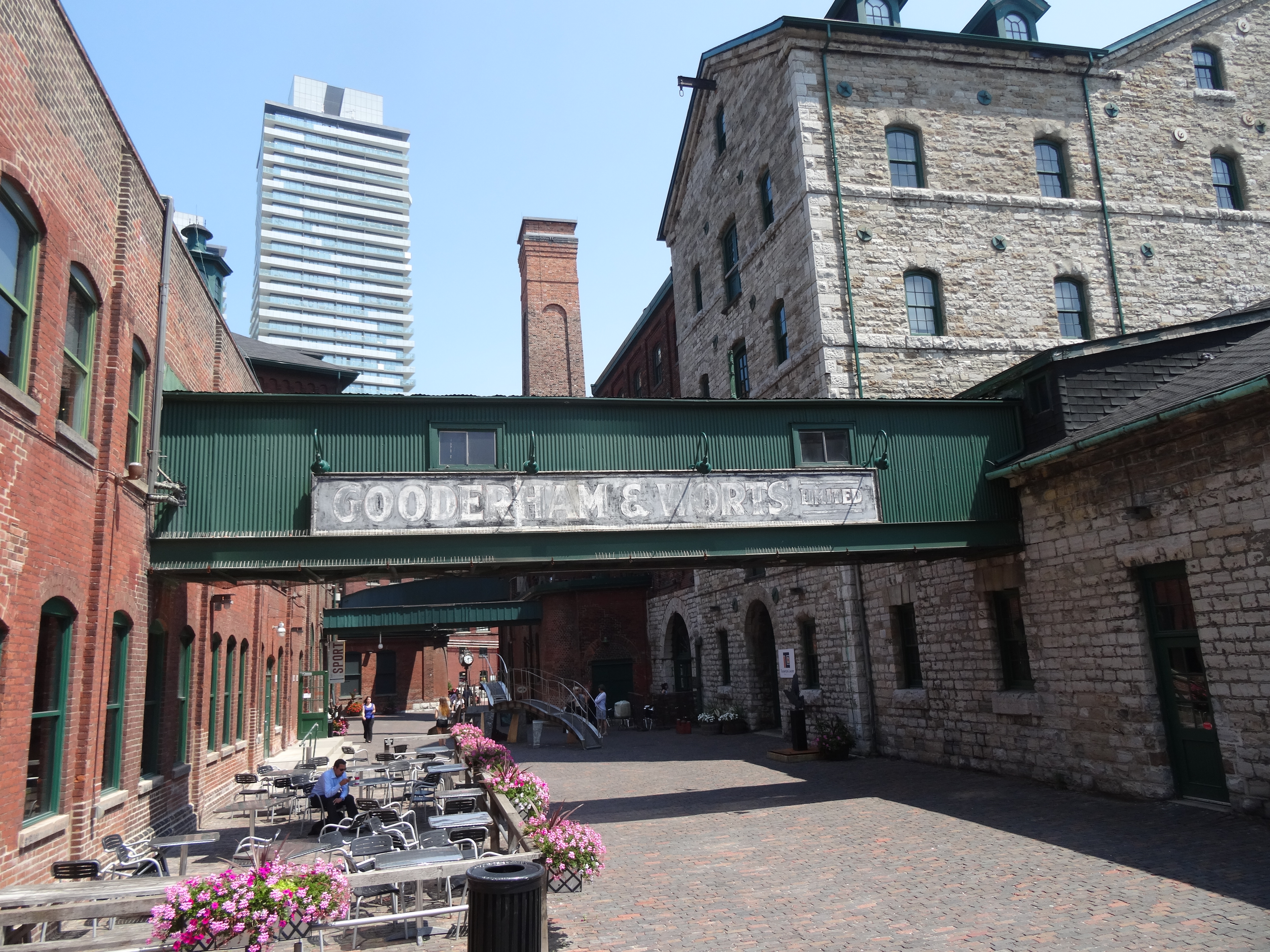
The Distillery Historic District
Taking up two city blocks just east of downtown near Lake Ontario’s shore, “The Distillery” is Toronto’s hub for artisans of all kinds. All businesses are locally owned and there are no name brands sold in the assortment of specialty shops and galleries.
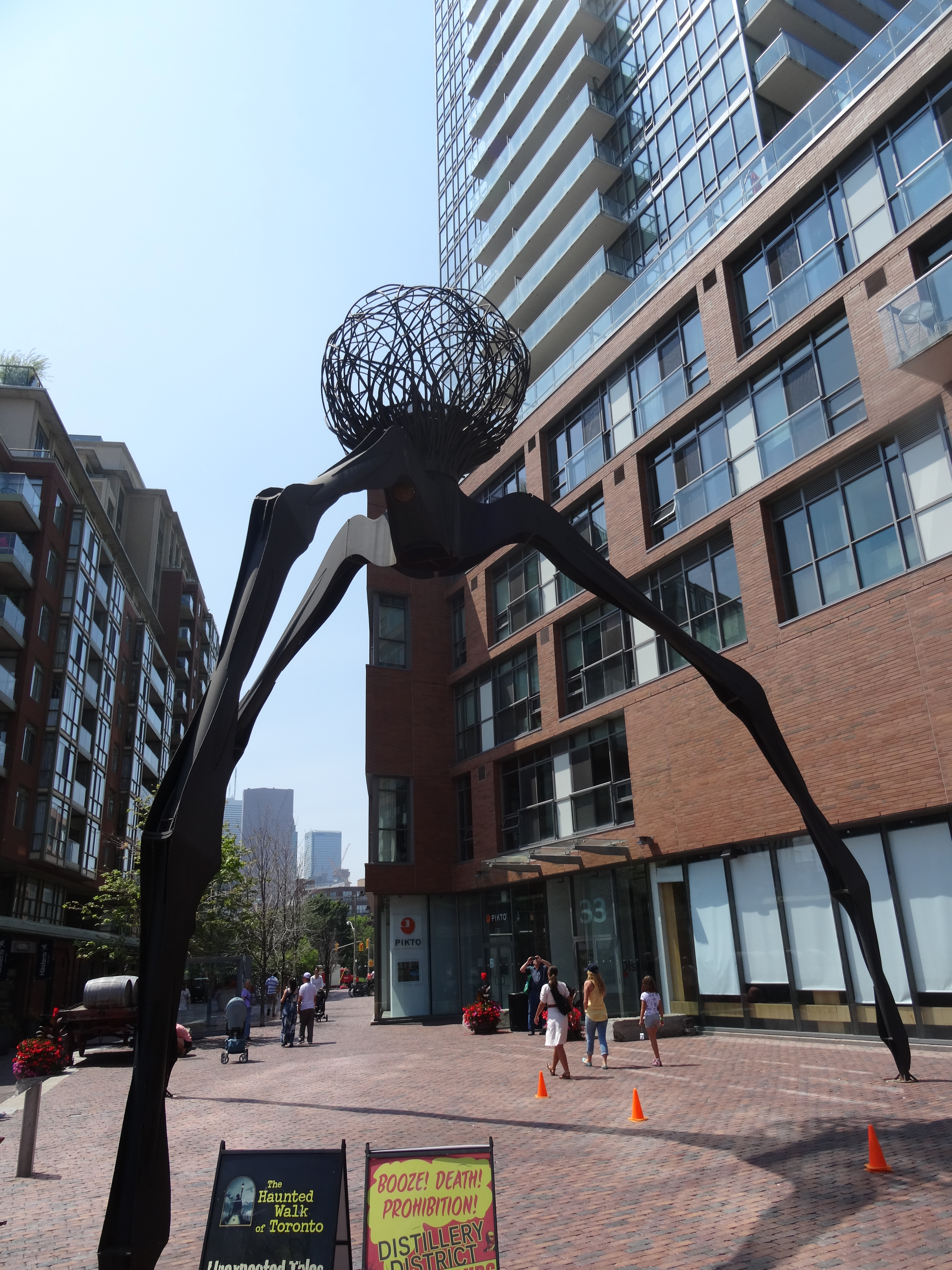
Spider sculpture in the Distillery Historic District
The site is a revitalized whiskey and spirits distillery that operated from 1832 to 1990. The many buildings that wind through the old Gooderham & Worts Distillery are the largest collection of Victorian industrial architecture in North America.
Sidewalk cafe in The Distillery Historic District
They were built at varying times to keep up with company growth, but maintain a consistent look throughout. In the period between when the distillery closed in 1990 and when it reopened in 2003 as a residential and shopping area, the site served as a set to many films including Chicago and Cinderella Man.
The district was relatively subdued on the Monday we visited, but we understand that the reverse is true on weekends when it is full of live music and other performance artists.
Toronto Zoo
The trip to the Toronto Zoo was a spontaneous decision after we eagerly arrived at the famous St. Lawrence Market to find that it is closed on Mondays. The zoo is located in a suburb about 20 miles northeast of downtown Toronto and ended up being about an hour drive in traffic.
I think our impression of the zoo would have been more positive had it not been an unusually hot afternoon for Toronto.
Sleepy white fox
The poor animals were sluggish in the heat and some, including this poor grizzly, appeared to be outright stressed.
This pacing grizzly bear kept testing the electric fence. It was disturbing.
They looked unhappy and we just felt bad for them.
Little ice on a warm day for the polar bear
Thankfully, the day – our last in Toronto — ended much better. Our host’s daughter had made dinner for us and we enjoyed the delicious meal of Indian Butter Chicken with rice and steamed broccoli on the deck with a bottle of Niagara Valley red blend wine. We were pleased to get to visit with our host again and share more stories.
The following morning we were able to meet our host’s friend that had helped with the apartment’s remodeling. Mary greeted us with a small cooler she had packed with drinks for our drive to Pittsburgh, which we very much appreciated – the cherry on top of our already high regard for Canada and Canadians!
Caroline seeing us off on our return to the U.S.
Niagara Falls, Ontario
We’d been told by multiple sources to see Niagara Falls from the Canadian side. We were glad to hear this since the Canadian border was also the most logistically convenient choice for us. The city of Niagara Falls, Ontario is very clean and quaint, and surprisingly understated despite the fact that it is a top tourist destination.
Niagara Falls, Ontario
Hotels and businesses, including a casino, tastefully blend in with office buildings that sit along the greenspace that separates them from Niagara Gorge and its spectacular falls.
Queen Victoria Park, Niagara Falls, Ontario
Although I had seen the falls in photographs and films, I was surprised to find that there are actually two separate falls on the Niagara River. Horseshoe Falls is probably the most photographed and sits on the Canada side.
Horseshoe Falls, Niagara Falls, Ontario
The falls on the U.S. border is simply named the American Falls.
American Falls taken from Niagara Falls, Ontario
The water of the Niagara River flows at 35 mph moving water from Lake Erie into Lake Ontario. Photos and films do not adequately portray the beauty and power of the water flowing over the 180 foot cliff.
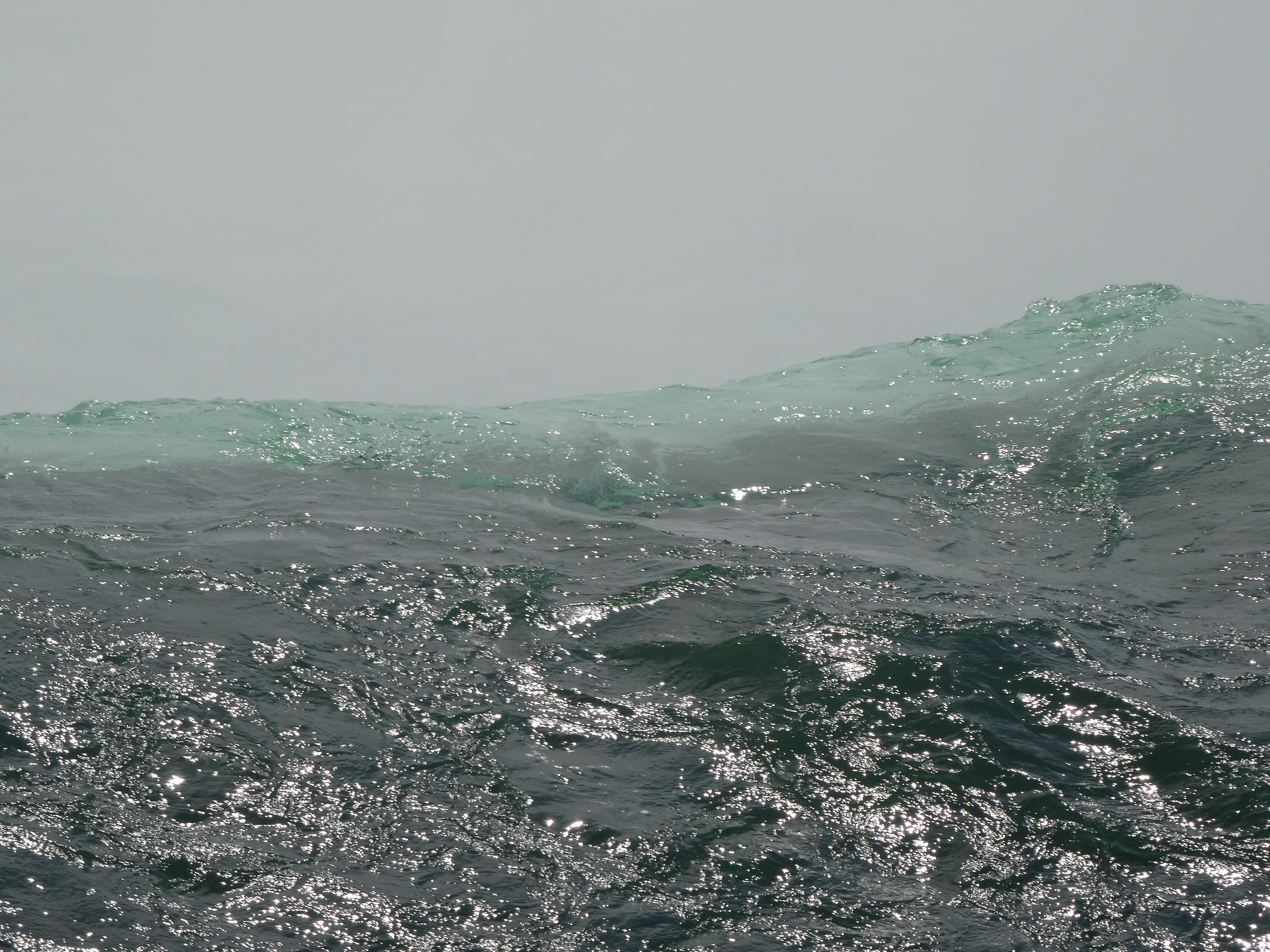
Crestline of Horseshoe Falls, Niagara Falls, Ontario
Any attempt I make to describe it with words will fall far short of the actual experience. The best I can do is….Wow! I advise anyone who has an opportunity to experience Niagara, to do so!
This is a record of Trey & Martha's 2014 U.S. travel adventures


 while traversing the east bank of the Madison River, between canyon walls, and along the shorelines of several lakes.
 Quake Lake had been formed exactly fifty-five years prior when the combination of an earthquake, massive landslide, and subsequent rushing, rising water flooded the valley.


 included a seventy-four mile trek across the top of Idaho.

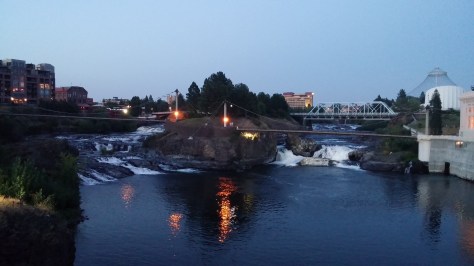 The Spokane River runs through the city’s center. A river walking path was being extended as a part of a larger Riverfront Park renovation plan.
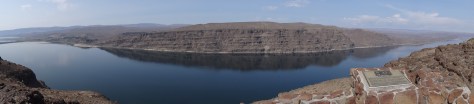 Ginkgo Petrified Forest State Park lay just beyond the opposite bank and was once home to the Wanapums, an indigenous, peaceful tribe of fishermen who are near extinction.

 The sighting renewed our energy and enthusiasm for the remaining two hour drive to our campsite.


























































 wewillfigureitoutblog